


Key Takeaways
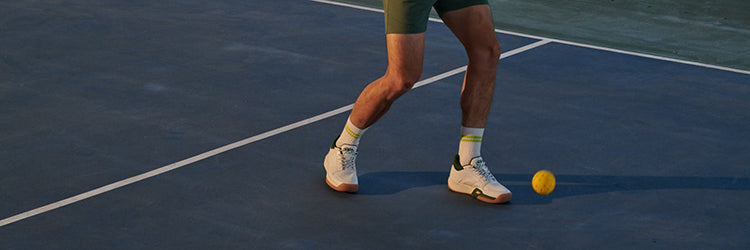
- Pickleball demands lateral movement, quick stops, and sharp direction changes, so court-specific footwear matters far more than general athletic shoes.
- Court grip comes from the outsole design, specifically herringbone or CNC-cut tread patterns that hold on hard surfaces without slipping.
- Lateral support is one of the most critical features because most movement in pickleball happens side to side, not forward and back.
- Cushioning technology, such as ETPU foam, helps absorb repeated impact and returns energy so your legs stay fresh through long sessions.
- Sole design affects both traction quality and whether the shoe leaves marks on indoor court surfaces.
- Purpose-built pickleball shoes outperform repurposed running or casual shoes because they are engineered around the sport's specific demands.
Pickleball is one of the fastest-growing court sports in the world, and for good reason. It is fast, social, and competitive at every level. But as the game gets more serious, so does the gear. One question comes up constantly among new and experienced players alike: what kind of shoes are actually good for pickleball?
The answer is not as simple as "any athletic shoe." Pickleball puts very specific demands on your feet, ankles, and knees. The wrong footwear can slow you down, affect your footing, or simply wear out faster than the sport deserves. The right shoes, on the other hand, can feel like a genuine competitive advantage.
This guide breaks down every key factor to help you choose footwear that fits your playing style, court surface, and performance goals.
Why Does Footwear Choice Matter So Much in Pickleball
Pickleball is a short-court sport. Unlike tennis or running, most of your movement happens within a relatively tight area, but that movement is explosive and multidirectional. Research in court sports consistently shows that lateral movement accounts for a significantly higher share of total court movement compared to straight-line running.
That means your feet are constantly pushing sideways, planting hard, pivoting, and recovering. A running shoe is designed for forward motion. A casual sneaker offers no meaningful lateral structure. Neither is a good match for what pickleball actually demands.
Court-specific shoes solve this by combining the right tread pattern, midsole technology, and upper support to handle the sport's unique movement profile.
What Kind of Sole Design Works Best for Pickleball
The sole is where performance starts. For pickleball, you want a non-marking rubber outsole with a tread pattern designed for hard court surfaces. Herringbone patterns are widely regarded as the most effective for court sports because they provide traction in every direction, not just front to back.
CNC-cut tread takes this further by using precision manufacturing to create sharper, more consistent grip channels. This results in cleaner traction on pushes and stops compared to standard stamped soles.
What you want to avoid is a smooth or lightly textured sole, which reduces grip significantly on polished indoor courts. You also want to avoid deep lugged soles (common on trail running shoes), which are built for soft ground and offer poor feel and control on hard court surfaces.
Non-marking rubber is also essential if you play indoors. Courts at recreation centers and sports clubs often require non-marking shoes to protect the flooring.
How Important Is Lateral Support in Pickleball Shoes
Lateral support is arguably the single most important structural feature in a pickleball shoe. When you push off to your left or right for a wide ball, your foot needs a stable platform underneath it. Without proper lateral reinforcement, the shoe can flex or roll outward under load, reducing both power transfer and stability.
A carbon fiber shank built into the midsole is one of the most effective solutions for this. Carbon fiber is lightweight but rigid, meaning it resists unwanted flex during side-to-side movement while not adding unnecessary weight to the shoe. Players who have switched to shoes with carbon fiber midsole reinforcement often describe noticeably sharper, more confident cuts.
Mid-cut designs add another layer of lateral protection by wrapping slightly higher around the ankle. This gives the ankle a bit more structure during wide reaches and quick changes of direction, particularly valuable for players who have had previous ankle issues or who play very aggressively at the baseline.
What Role Does Cushioning Play
Pickleball involves a lot of repetitive impact. Every step, plant, and landing sends force up through the foot and into the knee and hip. Over a two-hour session, that adds up considerably, especially on hard court surfaces.
The right cushioning does two things at once. It absorbs impact on the way down and returns energy on the way up. ETPU (expanded thermoplastic polyurethane) foam is one of the most effective modern midsole materials for this purpose. It is softer and more responsive than traditional EVA foam, meaning it cushions landings without feeling dead or compressive over time.
Players who have made the switch to ETPU-cushioned shoes frequently report less foot fatigue during long sessions and reduced soreness in the days after heavy play. For older players or anyone with joint sensitivity, cushioning quality can be a meaningful factor in how long they can stay on the court.
Does Comfort Come Down to More Than Just Cushioning
Yes. Total comfort in a court shoe involves several elements working together: the insole, the upper fit, the toe box width, and the collar padding.
The insole is where your foot actually rests, so it has a significant impact on both comfort and stability. A non-slip insole that locks the foot in place prevents internal movement within the shoe, which reduces blisters and improves control during quick footwork. Insole technology has advanced significantly, and performance-grade insoles now contribute meaningfully to energy return and overall foot feel.
Toe box width is another frequently overlooked factor. A toe box that is too narrow creates pressure during lateral movements, where the foot naturally spreads slightly under load. A well-designed toe box gives the toes room to function naturally without sacrificing overall shoe width or fit.
The upper material affects breathability. Mesh uppers with structured overlays are the most common choice for court shoes because they allow airflow while still providing the overlays necessary for support during lateral movements.
How Does Durability Differ Between Playing Styles and Court Surfaces
Durability varies based on how aggressively you play and where you play most often.
Outdoor court surfaces (typically asphalt or concrete) are rougher and wear outsoles faster than indoor surfaces. If you play primarily outdoors, look for shoes with thicker, high-density rubber in the outsole, particularly in the toe drag zone at the front of the shoe. Toe drag during serves and reaching shots is one of the most common wear points in pickleball footwear.
Indoor courts are gentler on outsoles but require cleaner, more precise traction. The grip requirements are slightly different because polished hardwood or sport tile can be slippery under the right conditions.
Aggressive baseliners and players who make frequent wide sprints will typically wear through shoes faster than net-dominant players. The laces, stitching around high-wear zones, and outsole thickness all contribute to how long a shoe holds up under this kind of use.
After four or more months of heavy play (eight to ten hours per week), a well-constructed pickleball shoe should show minimal failure at common stress points. Shoes that hold up at the laces, outsole edges, and toe zone under that kind of load are built to a higher standard than average athletic footwear.
Should You Choose a Low-Cut or Mid-Cut Pickleball Shoe
This comes down to your playing style and personal preference.
Low-cut shoes offer more freedom of movement and feel lighter on the foot. They are well-suited for agile, fast-moving players who prioritize speed and quickness over ankle coverage. Players with strong ankle stability and no history of sprains often prefer the low-cut option.
Mid-cut shoes wrap slightly higher around the ankle and provide additional support during lateral transitions. They suit players who prefer a more planted, stable feel, or those who want extra protection during aggressive wide movements. The trade-off is a modest reduction in ankle mobility, though modern mid-cut court shoes are designed to minimize this effect.
Neither option is universally better. It depends on how you move, how you play, and what your body needs.
How DAPS Approaches Pickleball Footwear
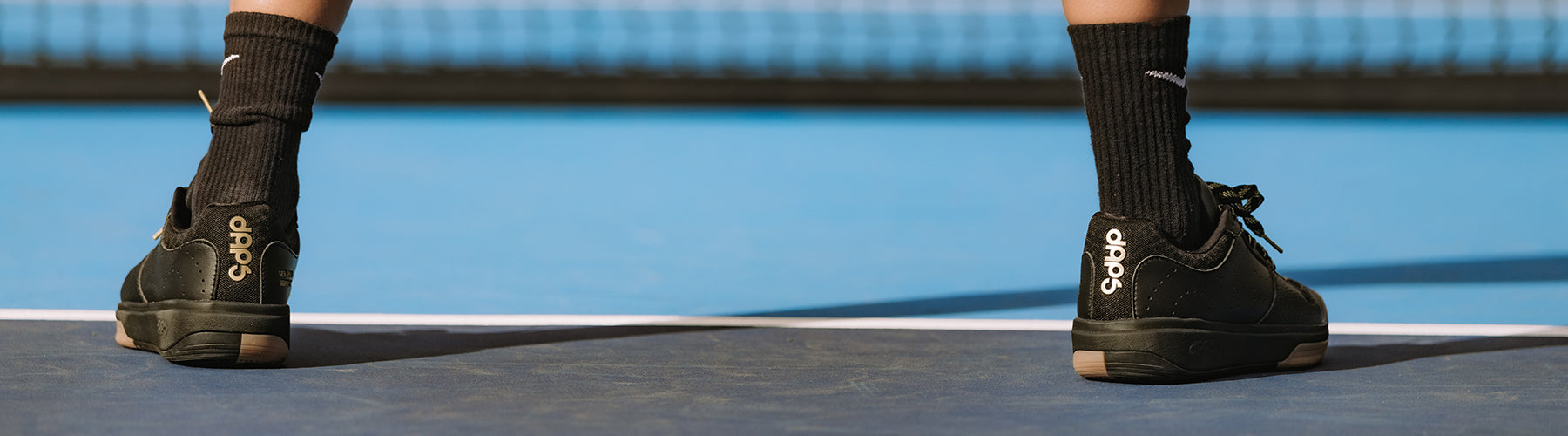
DAPS built their pickleball shoes from the ground up specifically for this sport. Rather than adapting tennis or basketball shoes, DAPS designed the DESI around the actual movement demands of pickleball, incorporating biomechanics lab data from independent testing at Heeluxe and input from competitive players.
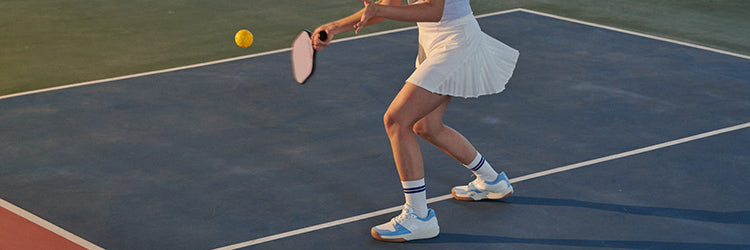
The DESI line includes the DESI Low (lightweight, low-cut for agility and fast footwork) and the DESI Mid (added ankle coverage for stability without sacrificing speed). Both models feature ETPU foam cushioning for energy return, a carbon fiber shank for lateral stability, CNC-cut herringbone outsoles for precise traction, and Blumaka NonSlip insoles that lock the foot in place for stronger drive and less internal movement.
DAPS offers men's and women's versions, with the women's line designed specifically for women's feet and movement patterns rather than being a resized men's shoe. Independent testing at Heeluxe confirmed stronger performance across energy return, stability, and movement efficiency compared to standard court footwear.
Players with wide feet have noted the toe box as a standout feature, while those with narrow feet appreciate the secure midfoot structure. The non-marking rubber outsole means they work on any court without leaving marks.
You can explore the full DESI collection at DAPS.
Final Takeaway
The right pickleball shoe combines court grip, lateral support, responsive cushioning, smart sole design, and durable construction in a package that suits your playing style and court surface. These are not minor details. They directly affect how you move, how long you can play, and how you feel the day after a long session.
DAPS designed the DESI line with exactly these priorities in mind, using lab testing, real-player feedback, and fourth-generation footwear expertise to build a shoe that is genuinely purpose-built for pickleball. Whether you prefer the lightweight agility of the DESI Low or the added stability of the DESI Mid, both options bring court-specific performance that general athletic footwear simply cannot match.

Leave a comment
This site is protected by hCaptcha and the hCaptcha Privacy Policy and Terms of Service apply.