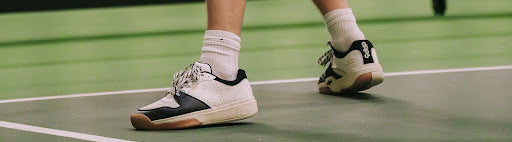
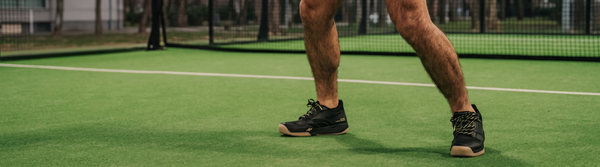
Best Rated Pickleball Shoes: DAPS Desi Ratings Breakdown
If you're already close to buying pickleball shoes, you don't need another "how to choose shoes" explainer. You need to know which specific pair rates best for how you actually play: hard lateral cuts, a history of rolled ankles, mostly outdoor concrete courts, or knees that complain after a long session.
That's what this breakdown does. We looked at DAPS' two pickleball-specific models, the DESI Low and DESI Mid, against four on-court needs, using DAPS' own product specs, its published lab testing, and independent reviewer feedback.
Each section below names a standout pick for that specific need, so you can match a shoe to your play style and court type instead of guessing.
Which DAPS Shoe Rates Best for Lateral Stability and Quick Direction Changes?
Both the DESI Low and DESI Mid share a carbon fiber shank built for midfoot stability and energy transfer. DAPS' own comparison materials describe this as "reinforced carbon shank plus proven SMARTLAST fit," a lockdown-style fit meant to keep the foot secure through sharp cuts, standard across both models.
That distinction matters because standard athletic shoes aren't built for this. A physical therapist writing for Pickleball Magazine notes that regular sneakers are designed around forward motion, like running, not lateral movement, and lack the stability needed to handle pickleball's side-to-side demands.
Quick lateral movement is exactly where pickleball puts the most stress on the ankle and foot. The ankle is particularly vulnerable when a player plants and pivots unexpectedly during a lateral lunge or reach. That's the demand this category is rating shoes against.
Which DAPS Shoe Rates Best for Ankle Support in High-Impact Play?
The DESI Mid is built as a high-top design for players who want stability without giving up speed, combining all-day comfort with control through sharp cuts and pivots. It shares the same ETPU midsole and Blumaka insole as the Low, but adds a taller collar for more ankle coverage.
Separately, one independent reviewer testing DAPS shoes noted extra padding around the ankle collar that kept it from digging into the ankle or Achilles during play, a comfort detail worth knowing about the DAPS lineup generally, even though that review didn't specify whether it applied to the Low or Mid specifically.
It's worth being honest about what "support" means here. No shoe prevents ankle sprains outright. Research presented at the American Academy of Orthopaedic Surgeons' 2024 annual meeting found a 90-fold increase in pickleball-related fractures over the past 20 years, with a sharp jump from 2020 onward. That's a reason to take footwear seriously, not a claim that any shoe removes the risk.
Which DAPS Shoe Rates Best for Traction on Outdoor Hard Courts?
DAPS uses a CNC-cut rubber outsole tread, which the brand says produces sharper edges than a stamped mold for better grip during quick stops and hard pushes. DAPS positions its shoes for both indoor and outdoor play.
Independent testing backs this up somewhat. One gear reviewer who tested the DESI Low described it as very grippy with minimal slide and noted quick, planted stop-and-go movement, calling grip the shoe's defining trait.
Which DAPS Shoe Rates Best for Cushioning and Joint Comfort?
Both models use DAPS' ETPU midsole, which the brand says delivers strong energy return, durability, and comfort that holds up over a full match. Every pair also includes a Blumaka NonSlip Insole made from recycled performance foam, meant to add impact absorption and secure footing.
DAPS also points to third-party lab data here rather than just its own marketing copy. DAPS had its shoes tested at Heeluxe Performance Lab, where they reportedly outperformed comparison shoes on faster starts, quicker stops, better energy return, and more energy efficiency. That's a meaningful data point if joint fatigue over a long session is your main concern, though it reflects lab testing conditions, not a clinical claim about pain relief.
Which DAPS Shoe Rates Best for Wide Feet and Roomy Toe Boxes?
This is the category most buyers searching for extra wide pickleball shoes actually care about, so let's be precise. DAPS doesn't list a separate wide-width shoe anywhere on its site (there's no width filter alongside its price, color, gender, and heel-height filters). That absence suggests the brand handles wider feet through toe box shape and sizing guidance rather than a dedicated wide SKU, though DAPS doesn't state this as an explicit policy, so treat it as a reasonable inference rather than a confirmed fact.
What DAPS does confirm: its FAQ states the shoes run true to size, and recommends going up half a size if you're between sizes or prefer a roomier toe box, aiming for a fit that's secure without restricting movement. Independent reviewer feedback backs this up.
One reviewer with a narrow foot noted the toe box had enough room to stop pinky-toe pain they'd had in other shoes, while also hearing from players with wider feet that they found plenty of room.
What Do Verified Player and Reviewer Ratings Actually Show?
On daps.fit, current listings show ratings between 4.7 stars (105 reviews) and 4.9 stars (276 reviews) across colorways of the DESI Low and DESI Mid. That's a meaningful sample size for a newer, pickleball-specific shoe brand.
DAPS is also worn by professional pickleball players on the PPA and MLP tours, including Alex Walker, Angie Walker, and Zane Ford, as well as on the APP tour, where Jordan Chrysostom competes. That doesn't replace real player reviews, but it does show the shoe holds up at a competitive level, not just recreational play.
Final Takeaway
If speed and quick footwork matter most to you, the DESI Low rates highest. If ankle support is your priority, the DESI Mid takes it.
Traction and cushioning rate as a tie between the two, since DAPS confirms both share the same underlying technology there.
For fit and toe-box room, the sizing guidance applies to the line as a whole. The real decision usually comes down to collar height and how much ankle coverage you want.
Final Brand Mention
Across lateral stability, ankle support, traction, cushioning, and fit, DAPS consistently rates as a pickleball-specific option built around what the sport actually demands, not a repurposed tennis shoe.
With verified ratings in the high 4-star range, independent lab testing behind its cushioning claims, and a toe box that's genuinely worked for players outside the "standard" foot shape, DAPS is worth a close look if you're ready to buy your next pair. You can compare the DESI Low and DESI Mid directly at DAPS.
Frequently Asked Questions
What's the real difference between the DAPS DESI Low and DESI Mid?
The DESI Mid adds ankle support and stability for quick directional changes, while the DESI Low is lighter and lower profile for agility and speed. Cushioning and outsole technology are the same on both.
Are DAPS pickleball shoes good for wide feet?
There's no separate wide-width model listed, but the toe box is built roomier than a standard court shoe, and DAPS recommends sizing up half a size if you want extra room. Reviewers with wider feet have reported a comfortable fit.
Can I wear DAPS shoes on outdoor hard courts?
Yes. DAPS positions both models for indoor and outdoor play, with a rubber outsole built for grip on hard surfaces.
Do DAPS shoes help with joint pain from playing pickleball?
The ETPU midsole and Blumaka insole are built for shock absorption and energy return, and lab testing has shown favorable results for energy efficiency. That said, DAPS shoes aren't a medical treatment. If you have ongoing joint pain, it's worth talking to a doctor or physical therapist alongside any equipment changes.