


Key Takeaways
- Running shoes are built for forward, heel-to-toe motion, which is the opposite of how you move in pickleball.
- Court sports like pickleball demand fast lateral movement, sharp pivots, and sudden stops that running shoe soles are not engineered to support.
- The soft, cushioned midsoles in running shoes can feel unstable underfoot during quick side-to-side shifts on a hard court.
- Running shoe outsoles use directional tread patterns designed for straight-line grip, not the multi-directional traction pickleball requires.
- Wearing the wrong footwear on court can affect how confidently and comfortably you move through a match.
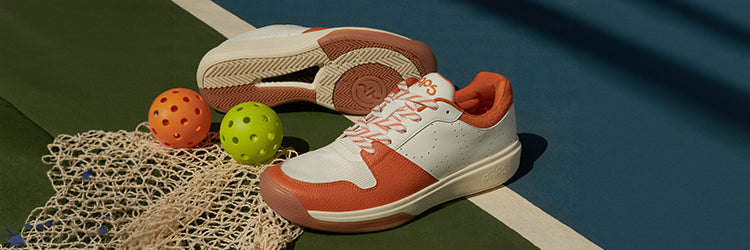
- Court-specific shoes, like those from DAPS, are engineered from the ground up for the exact movement demands of pickleball.
If you have ever walked onto a pickleball court in your running shoes, you are not alone. It is one of the most common footwear mistakes new players make, and honestly, it is an understandable one. Running shoes feel athletic, they are comfortable, and they look the part. But looking the part and performing the part are two very different things.
Pickleball is a game of rapid direction changes, sharp lateral cuts, and explosive stops at the kitchen line. Every movement pattern in this sport runs counter to what running shoes are designed to do. Understanding the difference between these two types of footwear, and why it matters for your game, is one of the simplest performance upgrades you can make.
This article breaks down exactly why running shoes fall short on the pickleball court, what court shoes offer instead, and what to look for when choosing the right footwear for your game.
How Are Running Shoes and Court Shoes Actually Different
What Running Shoes Are Built For
Running shoes are precision tools, but they are built for one thing: forward motion. Every design decision in a running shoe, from the elevated heel to the curved outsole to the thick, soft midsole cushioning, is optimized for a heel-to-toe stride in a straight line.
The cushioning in a running shoe is intentionally soft because it needs to absorb the repeated vertical impact of a runner's foot hitting the ground, stride after stride. That softness is a feature for running. On a pickleball court, though, that same softness creates a spongy, unstable platform underfoot during lateral cuts and sharp pivots.
The outsole of a running shoe also features a raised, flared edge around the sides. This shape is ideal for forward propulsion but works against a player trying to push off hard to the left or right. When your foot rolls sideways during a quick shuffle, a flared running shoe sole offers very little resistance to that motion.
What Court Shoes Are Built For
Court shoes take a fundamentally different approach. Instead of cushioning for vertical impact, they are built low to the ground with a wider, flatter base that gives you a stable platform for lateral movement. The midsole is firmer than in a running shoe, which may feel less plush when you first put them on but translates to better control and responsiveness when you are sprinting to the sideline or stopping hard at the net.
The outsole pattern on a quality court shoe is multi-directional, meaning the tread grips just as well when you push sideways as it does when you push forward. A review of court and running shoe design published on PubMed confirms that for court sports, optimal traction is the primary performance factor, while cushioning is secondary, which is the inverse of what running shoe design prioritizes.
Why Lateral Movement Changes Everything
The Movement Profile of Pickleball
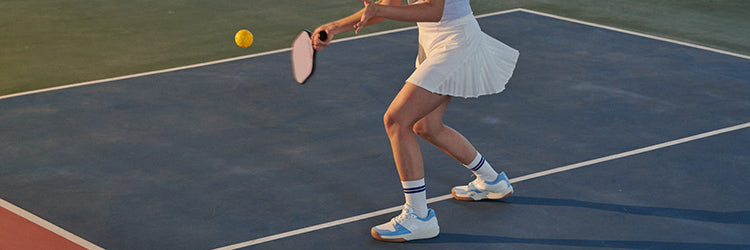
Pickleball is played on a compact court, and the nature of the game forces players into constant short bursts of movement in every direction. You are not running laps or jogging in a straight line. You are side-shuffling to a wide dink, sprinting forward to the kitchen, pushing back to defend a lob, and pivoting to track a cross-court shot, all within a single point.
Studies on court sport movement patterns consistently show that side-to-side movement accounts for a higher proportion of total court movement than forward running. Some estimates in related court sports put lateral movement at roughly 50 percent or more of all in-game footwork. That means a shoe built exclusively for forward motion is essentially mismatched with the primary demand of the sport.
Why Stability Matters More Than Cushioning on Court
When you push hard to your left to reach a wide ball, your foot rolls sideways against the inside of your shoe. A court shoe with reinforced sidewalls and a low, wide platform resists that roll and keeps your foot positioned correctly under your body. A running shoe with a high stack height and soft midsole offers significantly less resistance to that lateral roll, which increases the stress placed on the ankle and the surrounding muscles.
This is not about any single movement being inherently dangerous. It is simply about the fact that doing hundreds of lateral movements in a shoe that is not built to support them places cumulative stress on your joints and connective tissue over time, and makes each movement less efficient and less confident.
The Traction Problem: Why Running Shoe Grip Works Against You on Court
How Outsole Patterns Differ
Traction is one of the most visible differences between running shoes and court shoes, and it is one of the most practically important. Running shoes typically feature waffle-style or linear tread patterns designed to push off from a surface in a forward direction. These patterns channel grip backward as your foot propels you forward.
On a hard pickleball court, you need grip in every direction. You need to stop cleanly when moving to your right, push off hard when redirecting left, and hold your position when you are dinking at the kitchen line and shifting your weight back and forth. A herringbone outsole pattern, which is standard in quality court shoes, is specifically designed to provide this kind of multi-directional traction on hard court surfaces.
Court-Specific Outsoles and What They Do
Beyond the pattern itself, court shoe outsoles are made with rubber compounds calibrated for hard court surfaces. Indoor and outdoor courts place different demands on the outsole rubber, which is why some shoes are designed specifically for one surface or the other, and why quality court shoe brands invest heavily in outsole engineering.
Running shoe rubber is formulated for asphalt and trail surfaces. On a slick indoor court floor, a running shoe outsole may not grip as predictably during a quick direction change. On an outdoor hard court, the tread may wear down quickly because it was not designed to handle the type of friction a court sport generates.
What Happens to Shoe Performance Over Time
How Running Shoe Cushioning Breaks Down
The soft cushioning in running shoes is designed to handle vertical impact, but it wears down with repeated use. As the midsole compresses over time, it loses its ability to absorb shock and returns less energy with each stride. Runners typically replace their shoes every 300 to 500 miles for exactly this reason.
On a pickleball court, that same cushioning is put under a different kind of stress. Lateral cuts and hard stops create shear forces across the midsole that accelerate breakdown in ways that straight-line running does not. A shoe that still looks fine on the outside may have lost significant structural support long before the upper shows obvious wear.
How Court Shoes Handle Wear Differently
Court shoes are built with firmer, denser midsole materials that hold up better under the stresses of court sport movement. The outsole rubber on quality court shoes is also designed to maintain grip over extended play. Some court shoes feature outsole guarantees precisely because the rubber compounds are engineered for durability on hard court surfaces.
Players who spend two or three hours on the pickleball court several times a week will wear through a court shoe outsole faster than a casual player, but the shoe should maintain consistent grip and support throughout its lifespan.
How DAPS Approaches Court Shoe Design
DAPS builds pickleball shoes from the ground up, designed specifically for the movement demands of the sport. The DESI collection uses a CNC-cut tread pattern that produces sharper traction edges than stamped outsoles, giving the rubber a more precise grip on hard court surfaces in every direction.
The ETPU midsole in DAPS shoes is engineered to return energy efficiently while keeping the foot stable and low to the court. Rather than a soft, sink-in cushioning feel, the midsole is responsive, which means your energy from each push-off comes back to you rather than being absorbed.
The Blumaka NonSlip Insole keeps your foot locked into position inside the shoe during sharp direction changes, so the shoe and your foot move as one unit. A carbon fiber shank provides additional lateral stability through quick cuts and pivots. The upper is designed to add balanced support without adding unnecessary weight.
DAPS shoes were independently tested at the Heeluxe performance lab, with results showing stronger performance across energy return, stability, and movement efficiency compared to the tested field. The DESI Low and DESI Mid are available for both men and women, with the Mid offering added ankle height for players who prefer extra support.
Final Takeaway
Pickleball demands a very specific set of things from your footwear, and running shoes, as well-engineered as they are for their intended purpose, are simply not built to deliver them. The lateral movement, quick stops, and constant direction changes of pickleball call for a low-profile base, multi-directional traction, and firm lateral support that running shoes do not provide.
Choosing the right footwear is one of the most straightforward ways to support your game, your comfort, and your long-term enjoyment of the sport. DAPS was built specifically for this. From the CNC-cut herringbone tread to the energy-returning ETPU midsole and the Blumaka NonSlip Insole, every element of the DESI shoe is engineered around how pickleball players actually move. If you are ready to make the switch, visit DAPS to find the right shoe for your game.

Leave a comment
This site is protected by hCaptcha and the hCaptcha Privacy Policy and Terms of Service apply.