


Key Takeaways
- Outdoor courts are hard and abrasive. Shoes built for indoor use wear down fast and grip poorly on asphalt or concrete.
- The outsole rubber compound matters more outdoors. CNC-cut tread gives sharper grip edges than stamped molds on rough surfaces.
- Lateral stability is non-negotiable outdoors. Quick side-to-side cuts on hard courts put real stress on ankles and knees without proper support.
- Cushioning must handle repeated hard-surface impact. Running shoe foam compresses quickly outdoors; purpose-built court foam holds up longer.
- A quality insole keeps your foot from sliding inside the shoe during explosive movements, improving control without relying on lace-tightening.
- Generic tennis shoes and running shoes are not designed for pickleball's short-court movement pattern and will underperform outdoors from the first session.
Most players who choose outdoor pickleball shoes are not thinking about the right things. They look at price, color, or just grab what they already have on the shelf. Then they wonder why their feet hurt after 30 minutes, why the sole looks worn after a few weeks, or why they keep feeling like they might slip on that push to the left.
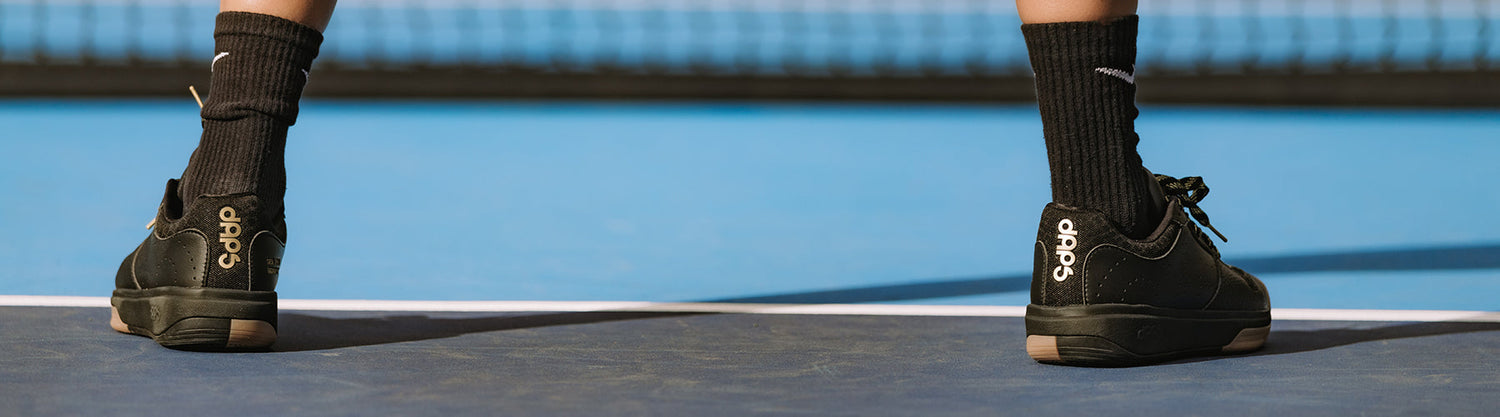
Outdoor pickleball courts are a different world from gym floors and indoor facilities. Asphalt and concrete are rougher, less forgiving, and they destroy shoes that were not made to handle them. The movement pattern in pickleball, which involves frequent lateral cuts, quick stops, and explosive drives off both feet, is also fundamentally different from running or even most court sports. DAPS designed the Desi shoe around exactly these demands.
This article breaks down exactly what to look for when you choose outdoor pickleball shoes, and explains why the most common choices players make are the wrong ones.
1. Does the Outsole Actually Grip on Hard Outdoor Surfaces
This is the feature that gets ignored most often. Players assume any rubber outsole will grip the court. But the type of rubber and the tread pattern make a significant difference on rough outdoor surfaces like asphalt or textured concrete.
Indoor court shoes use softer rubber formulated for gym floors. That rubber picks up grit and loses grip quickly on rough outdoor surfaces. Harder rubber compounds last longer outdoors but need a tread pattern designed to bite into the surface rather than skim over it.
CNC-cut tread patterns produce sharper tread edges than stamped molds. Those sharper edges grip better through quick stops and hard lateral pushes, which is exactly what outdoor pickleball demands. When you push off to the right to chase a shot, your shoe's outsole is working hard. Soft, generically treaded rubber will not hold that cut reliably on outdoor courts.
A non-marking rubber compound matters too. Many outdoor venues still apply non-marking rules, and quality outdoor pickleball shoes should meet that standard without sacrificing traction.
2. Does the Shoe Support Quick Lateral Movement
Pickleball is dominated by side-to-side movement.
Running shoes have zero lateral stability design. The midsole and upper are shaped for heel-to-toe movement. When you cut hard to the side in a running shoe, your foot rolls over the edge of the sole. That puts strain on the ankle and reduces your push efficiency.
A shoe built for lateral stability has a lower profile, a reinforced midfoot, and upper support that does not allow excessive roll. Some designs include structural components like a carbon fiber shank, which guides the foot through sharp angles with control rather than relying entirely on the upper material.
Outdoor courts add an extra challenge here. On asphalt, the surface is less forgiving when you land a lateral cut. Shoes with proper stability absorb and redirect that force more efficiently, reducing cumulative strain on joints over a long session.
3. Is the Cushioning Built for Repeated Hard-Surface Impact
Indoor shoes often use lightweight foam that works fine on sprung wood or synthetic gym floors. That foam was not designed to absorb the impact of landing on asphalt, and it shows. Many players who switch to outdoor play in indoor shoes notice foot soreness and fatigue much earlier in a session.
The key difference is in midsole foam density and energy return. A foam that compresses on impact and returns energy to the next step reduces cumulative fatigue over a long match. Foam that just compresses and stays compressed offers less protection over time and breaks down faster on hard surfaces.
ETPU (expanded thermoplastic polyurethane) foam is one of the higher-performing midsole materials in court footwear today. It offers energy return on each step and maintains its cushioning properties longer than standard EVA foam under repeated hard-surface impact. For outdoor pickleball on concrete or asphalt, that durability in cushioning is a practical performance factor, not just a comfort detail.
Thicker cushioning is not automatically better. Too much stack height raises your center of gravity and reduces lateral stability. The right balance is firm enough for control, cushioned enough to protect the foot across a full session.
4. How Durable Is the Outsole Rubber on Rough Courts
This is where most players feel the cost of their choice within weeks. Outdoor courts are abrasive. The gritty texture of asphalt and concrete grinds down rubber soles faster than any indoor surface. A shoe that lasts a full season indoors may show significant wear in a few weeks outdoors. Research published in Footwear Science and hosted on PMC found that traction performance metrics, including friction and fluid drainage, diminish measurably with outsole wear, and that tracking worn region size is a more reliable indicator of traction loss than time or distance alone.
Durability in the outsole depends on rubber hardness, the thickness of the rubber layer, and how the tread is designed. Tread patterns with too many fine grooves wear down at the edges quickly on rough surfaces. A more structured, durable tread layout handles that abrasion better over time.
The cost of ignoring this is straightforward. A worn outsole means less grip. Less grip means you are slower, less stable, and less confident in your cuts. Players often assume their fitness or technique is slipping when it is actually their footwear that has degraded underneath them.
When evaluating outdoor pickleball shoes, look for rubber outsoles specifically rated or designed for hard court use. This is a different spec than indoor or general court rubber, and it makes a real difference in how long the shoe performs at the level you bought it for.
5. Does the Insole Actually Keep Your Foot in Place
Most standard insoles in athletic shoes do one thing: add a layer of cushioning underfoot. That is useful, but it is not the same as keeping your foot locked in position during explosive play.
When your foot slides forward inside the shoe as you brake, or shifts laterally as you cut, you lose the mechanical connection between your foot and the ground. That fraction of lost connection affects your push-off efficiency, your balance, and your ability to react quickly to the next shot. Lacing up tighter is not a real solution because over-tightening causes other problems including poor circulation and toe compression.
A non-slip insole addresses this differently. Purpose-built non-slip insoles create friction between the foot and the shoe's interior, reducing that internal slide without the need to cinch laces uncomfortably tight. This keeps the foot positioned correctly through each cut, stop, and drive.
For outdoor pickleball on hard courts, where movement speeds and surface firmness both increase, having that interior control is especially important. It is one of those features players do not notice until they try a shoe that has it, and then going back to a standard insole feels obviously wrong.
Why Generic Tennis Shoes and Running Shoes Fall Short Outdoors
Tennis shoes and running shoes are legitimate footwear for their intended uses. The problem is that pickleball's movement pattern, court surface, and intensity profile are all different enough that those shoes are genuinely not optimized for outdoor pickleball.
Running shoes are designed for forward motion and heel-to-toe roll. Their cushioning is tuned for that movement. Their outsoles have traction designed for pavement or track, not lateral court cuts. Their uppers offer no lateral stability by design.
Tennis shoes are closer, but most are engineered for the demands of full tennis courts, including sliding on clay or moving through longer baseline rallies. Pickleball's short-court, rapid-fire lateral game is a different stress profile. Outdoor pickleball also demands faster energy return and more precise grip control than most tennis shoes are tuned for.
General athletic shoes wear down on outdoor court surfaces faster, provide less support for the specific movement pattern of pickleball, and leave players dealing with foot fatigue and instability that they often wrongly attribute to fitness or technique.
What a Purpose-Built Outdoor Pickleball Shoe Actually Looks Like
DAPS built the Desi shoe specifically for pickleball. Not adapted from tennis, not repurposed from another court sport, built from the ground up for the movement demands of the game.
The Desi uses a high-durability rubber outsole with a CNC-cut tread pattern, which gives sharper tread edges than stamped molds for better grip through stops and lateral pushes on outdoor surfaces. The midsole uses ETPU foam for energy return and long-session cushioning that holds up on hard courts. A carbon fiber shank provides structural stability through sharp directional changes without adding significant weight. The Blumaka NonSlip insole keeps the foot locked in position, reducing interior slide during explosive play.
The DAPS Desi was independently tested at Heeluxe Performance Lab and confirmed stronger performance across energy return, stability, and movement efficiency for short-court play.
DAPS offers both a Low and Mid version of the Desi for men and women, with the Mid providing additional ankle structure for players who want more support on outdoor courts. Both are available at DAPS.
Final Takeaway
Choosing outdoor pickleball shoes well comes down to five things: outsole grip on hard surfaces, lateral stability for court cuts, cushioning that holds up on rough courts, outsole durability over time, and insole grip to keep your foot positioned correctly inside the shoe. Getting any of these wrong affects your movement, your foot health, and how long the shoe actually lasts.
Generic athletic footwear tends to miss on most of those five points for outdoor pickleball. Shoes built specifically for the game, with the right materials for each layer of the shoe, perform and hold up noticeably better.
DAPS designed the Desi shoe from the ground up for exactly this kind of play. Every component, from the CNC-cut outsole to the carbon shank to the Blumaka NonSlip insole, addresses a real performance demand of outdoor pickleball. If you want footwear built for the sport rather than adapted from something else, visit DAPS to explore the full Desi lineup.
Frequently Asked Questions
Can I use indoor pickleball shoes on outdoor courts?
You can, but they will not perform well and they will wear down significantly faster. Indoor shoes use softer rubber and lighter foam that degrades quickly on the abrasive texture of asphalt and concrete. You will also notice less lateral grip on rough outdoor surfaces compared to a shoe built with an outdoor-rated outsole.
Are tennis shoes good enough for outdoor pickleball?
Tennis shoes are a better choice than running shoes, but they are still not purpose-built for pickleball's movement pattern. The short-court, rapid lateral game puts different demands on footwear than full-court tennis. A shoe built specifically for pickleball will perform better and hold up longer under those specific conditions.
What does lateral stability mean in a shoe, and why does it matter?
Lateral stability refers to how well the shoe controls your foot's sideways movement during cuts and directional changes. Without it, your foot can roll over the edge of the sole during side-to-side pushes, which increases ankle strain and reduces push efficiency. Shoes with carbon shanks, low-profile soles, and reinforced uppers handle this better than general athletic footwear.
How quickly does an outdoor pickleball shoe's outsole wear down?
That depends heavily on the rubber compound and how often you play. On rough outdoor courts, a shoe with a general-purpose or indoor-rated outsole can show significant wear within a few weeks of regular play. An outdoor-rated rubber compound with a durable tread design lasts considerably longer under the same conditions.
Is a thicker midsole better for outdoor play?
Not necessarily. More cushioning height raises your center of gravity, which can reduce lateral stability. The goal is foam that offers meaningful energy return and impact protection without adding so much stack height that you feel unstable during cuts. ETPU foam achieves that balance better than basic EVA foam for most outdoor players.
Do I really need a non-slip insole in a pickleball shoe?
It makes more of a difference than most players expect. Without insole grip, your foot slides slightly inside the shoe during hard stops and quick changes of direction. A non-slip insole removes that interior movement, giving you a more direct connection to the ground and improving your control on each cut.
What is the difference between the DAPS Desi Low and the Desi Mid?
The Desi Low has a standard court shoe profile, offering freedom of movement with solid lateral support. The Desi Mid adds additional ankle structure, making it a good choice for players who want more support around the ankle during outdoor play, or for those returning from ankle discomfort. Both use the same core technology, including the ETPU midsole, CNC-cut outsole, carbon shank, and Blumaka NonSlip insole.

Leave a comment
This site is protected by hCaptcha and the hCaptcha Privacy Policy and Terms of Service apply.