


Key Takeaways
- Hard courts are abrasive and demand a durable rubber outsole built specifically for rough surfaces, not gym floors.
- Lateral movement dominates pickleball, so stability through side-to-side cuts matters more than cushion volume alone.
- ETPU midsole foam maintains energy return and cushion longer than standard EVA foam under repeated hard court use.
- A carbon fiber shank provides lightweight structural support through sharp directional changes without adding bulk.
- The Blumaka NonSlip Insole keeps your foot locked inside the shoe so energy transfer stays efficient during fast footwork.
- The DAPS Desi Low and Desi Mid are purpose-built for pickleball, independently tested at Heeluxe, and worn by PPA and MLP professionals.
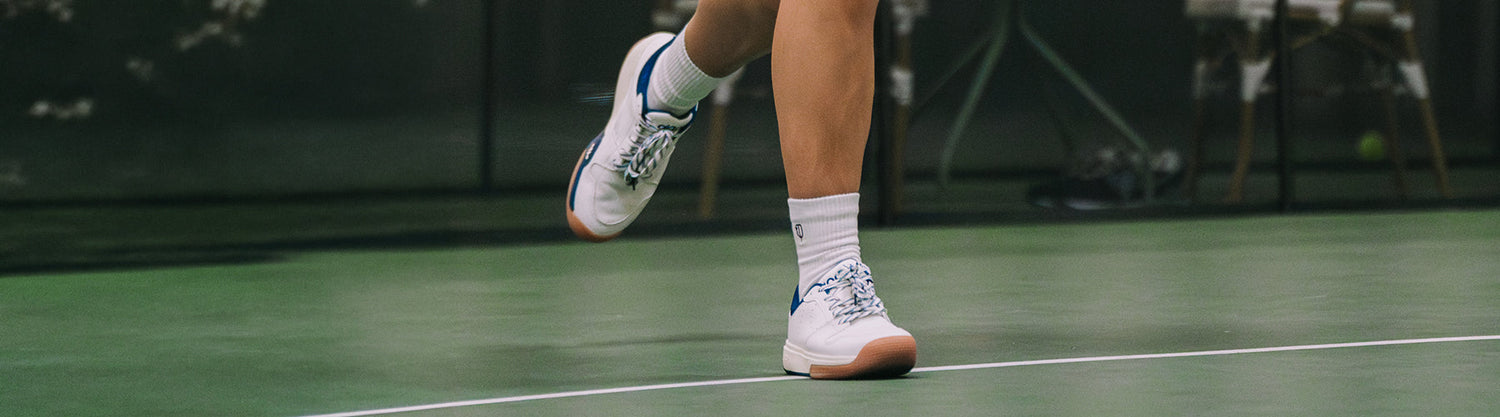
Outdoor pickleball on hard courts puts serious demands on a shoe. Concrete and asphalt are abrasive, impact forces are high, and the game itself is built around fast lateral movement in a compact space. Most shoes on the market are adapted from tennis or cross-training, and that shows quickly when you start playing regularly on rough surfaces.
This article covers what actually matters in an outdoor pickleball shoe, why each feature is relevant to hard court play specifically, and which options deliver on those needs.
What Makes a Shoe Actually Work on Outdoor Hard Courts?
Does Outsole Durability Really Matter That Much?
Yes, and it is usually the first thing to go on an underpowered shoe. Hard courts grind down soft rubber compounds faster than any other surface. The abrasive texture that gives you traction is the same texture eating through your outsole with every step.
CNC-cut tread patterns create sharper, more precise grip edges compared to stamped molds. In a stamped mold, the edges are rounded slightly during the manufacturing process. CNC cutting produces tighter geometry, which means cleaner contact with the court during quick stops and directional changes. Combined with a high-durability rubber compound, a well-cut outsole will outlast a generic shoe significantly on hard courts.
Non-marking rubber is also a practical requirement on most public courts. It grips the surface without leaving residue, which keeps you welcome at any facility.
Why Does Lateral Stability Matter More Than You Might Think?
Pickleball movement is different from almost every other sport. The court is compact, the kitchen line is close, and the game rewards players who can change direction sharply and repeatedly without losing balance.
Hard courts offer very little surface give, so the forces from every cut, push, and stop transfer almost entirely through your shoe and into your body. A shoe that flexes or twists under lateral load shifts stress onto your ankle and knee instead of managing it through its own structure. Research from the Journal of Sports Sciences confirms that ground reaction forces during lateral cuts on hard surfaces are substantially higher than on cushioned or clay surfaces, placing greater demand on footwear to manage load transfer through the ankle and knee.
A carbon fiber shank running through the midsole resists torsional flex, keeping the shoe stable through sharp cuts. Plastic shanks do the same job but are heavier and less responsive. Carbon fiber gives you the structural firmness without the added bulk. The upper also contributes: a structured AchillesLock collar keeps the heel seated and reduces slip during lateral pushes, which helps maintain clean footing through fast transitions.
What Kind of Cushioning Actually Holds Up on Concrete?
Standard EVA foam is everywhere in athletic footwear because it is lightweight and inexpensive. The problem is it compresses permanently over time. After a few months of regular hard court use, an EVA midsole has lost a meaningful portion of its original cushioning response, and you often do not notice until your knees start telling you.
ETPU (expanded thermoplastic polyurethane) foam is more resilient under repeated compression. It returns closer to its original shape after each impact, which means the cushioning stays more consistent over time. For players who are on hard courts multiple times a week, that durability difference compounds quickly.
The Blumaka NonSlip Insole adds another layer of performance by gripping the foot from inside the shoe. It reduces micro-movement that happens when your foot slides slightly forward during stops or backward during pushes. Less in-shoe movement means more efficient energy transfer and a more responsive feel through every step.
Best Outdoor Pickleball Shoes for Hard Courts
DAPS builds the Desi Low and Desi Mid specifically for pickleball, not adapted from another sport's template. Both have been independently tested at the Heeluxe Performance Lab and confirmed to outperform on energy return, stability, and movement efficiency. They are worn by PPA and MLP professionals including Alex Walker, Angie Walker, Zane Ford, and Jordan Chrysostom.
Every model in the Desi line shares the same core technology: CNC-cut rubber outsole, ETPU midsole, carbon fiber shank, CoolKnit Mesh upper with AchillesLock collar, and Blumaka NonSlip Insole. All are rated for both indoor and outdoor courts.
DAPS Desi Low (Men's) | $159.99 | Free US Shipping
The low-profile option for men who prioritize agility and quick lateral transitions. The lower silhouette keeps your foot closer to the court, which supports faster directional changes and a more responsive feel through short-court footwork.
- CNC-cut rubber outsole for precise grip and durability on abrasive hard court surfaces
- ETPU midsole for resilient cushioning and energy return across long sessions
- Carbon fiber shank for structural stability through sharp cuts without added weight
- Blumaka NonSlip Insole for locked-in foot positioning and efficient energy transfer
- CoolKnit Mesh upper with AchillesLock collar for breathability and heel security
- Non-marking rubber, suitable for indoor and outdoor courts
- Available in multiple colorways
- Fits true to size; go up half a size for more room in the toe box
Shop: DAPS Desi Low Men’s Pickleball Shoes
DAPS Desi Mid (Men's) | $174.99 | Free US Shipping
The same full technology stack as the Desi Low with a higher collar for players who prefer more ankle coverage or who have a history of ankle instability.
- All Desi Low technology: CNC-cut outsole, ETPU midsole, carbon fiber shank, Blumaka NonSlip Insole
- Higher collar adds ankle coverage without restricting lateral movement
- AchillesLock collar wraps the heel and ankle for a secure, consistent fit
- CoolKnit Mesh upper for breathability across outdoor sessions
- Non-marking rubber rated for indoor and outdoor use
- Available in multiple colorways
- Fits true to size; go up half a size for more forefoot room
Shop: DAPS Desi Mid Men’s Pickleball Shoes
DAPS Desi Low (Women's) | $159.99 | Free US Shipping
The women's version of the Desi Low shares the same pickleball-specific technology with a fit geometry designed for women's foot shape. The fit runs snug through the forefoot to support quick lateral cuts and fast footwork.
- CNC-cut rubber outsole for grip and durability on rough outdoor surfaces
- ETPU midsole for cushioning and energy return that stays consistent over time
- Carbon fiber shank for lateral stability through directional changes
- Blumaka NonSlip Insole for foot security and efficient energy transfer
- Snug performance fit designed to support fast footwork and quick cuts
- Non-marking rubber for indoor and outdoor courts
- Available in multiple colorways
- Worn by PPA and MLP professionals, including Kat Stewart and Angie Walker
- Go up half a size for more forefoot room
Shop: DAPS Desi Low Women’s Pickleball Shoes
DAPS Desi Mid (Women's) | $174.99 | Free US Shipping
The Women's Desi Mid adds a higher collar to the full Desi technology stack for players who want additional ankle support on hard courts.
- Full Desi technology: CNC-cut outsole, ETPU midsole, carbon fiber shank, Blumaka NonSlip Insole
- Higher collar for additional ankle coverage through lateral hard court play
- AchillesLock collar cradles the heel and Achilles for a locked-in, consistent fit
- CoolKnit Mesh upper for breathability across long outdoor sessions
- Non-marking rubber for any court type
- Same multiple colorways as the Women's Desi Low
- Go up half a size for more forefoot room
Shop: DAPS Desi Mid Women’s Pickleball Shoes
Final Takeaway
On outdoor hard courts, every feature in your shoe is working harder than it would on a softer surface. The outsole wears faster, the impact forces are higher, and the lateral demands of the game have nowhere to hide. A shoe adapted from another sport will show its limitations quickly.
The DAPS Desi Low and Desi Mid are built specifically for pickleball, with each component chosen for the movement patterns and surface demands of the game. They have been lab-tested at Heeluxe, trusted by PPA and MLP professionals, and carry a 30-day return policy with free US shipping. If you are serious about your outdoor game, they are worth a close look at DAPS.
Frequently Asked Questions
What is the difference between the Desi Low and the Desi Mid?
The technology is identical in both. The Low has a lower collar for players who want maximum agility and a closer-to-court feel. The Mid adds collar height for players who prefer more ankle coverage or who have ankle stability concerns. Neither restricts lateral movement.
Can I use tennis shoes for outdoor pickleball on hard courts?
You can, but tennis shoes are built for different movement patterns, primarily forward motion and lateral sliding on clay. Pickleball calls for sharper, more contained lateral cuts in a smaller space. Tennis shoes also tend to wear faster in the specific zones that pickleball footwork stresses most on hard courts.
Do the men's and women's versions share the same technology?
Yes. All four Desi models use the same core technology: CNC-cut rubber outsole, ETPU midsole, carbon fiber shank, Blumaka NonSlip Insole, CoolKnit Mesh upper, and AchillesLock collar. The fit geometry differs between men's and women's versions to match each foot shape.
Are these shoes good for both indoor and outdoor courts?
Yes. The DAPS Desi line is rated for both. The non-marking rubber outsole meets indoor gymnasium requirements while the durable compound handles outdoor abrasive surfaces.

Leave a comment
This site is protected by hCaptcha and the hCaptcha Privacy Policy and Terms of Service apply.