




Questions, answered
What is a short court
performance shoe?
The short answer
A court shoe engineered for racquet sports played on a court much shorter than a tennis court, where points are won with lateral cuts, hard stops and instant restarts rather than long baseline running. Pickleball, padel and TYPTI all load the foot that way, so DAPS builds one platform for all three.
Independently measured at Heeluxe.

FAQ
Everything people ask us.
Short court, sport by sport, plus fit, the engineering and how orders work. Nothing here is written to fill a gap: every answer traces to the Heeluxe report, the technology page or the store's own terms.
The short court
What the category is, and why DAPS built for it rather than adapting a tennis shoe down.
What is a short court performance shoe?
A short court performance shoe is a court shoe engineered for racquet sports played on a court much shorter than a tennis court, where points are won with lateral cuts, hard stops and instant restarts rather than long baseline running. It needs traction that bites and releases cleanly on a pivot, a midfoot that will not twist under a hard cut, and cushioning that returns energy on the next push instead of only absorbing impact.
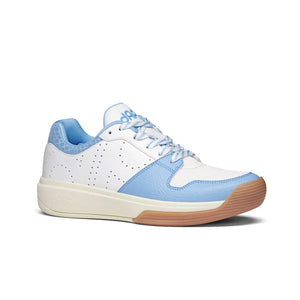
The DAPS DESI is built to exactly that brief: a CNC-cut non-marking outsole, a carbon fiber shank through the midfoot, an ETPU midsole and a removable Blumaka NonSlip insole.
Link to this answerWhich sports are played on a short court?
Pickleball, padel and TYPTI. A pickleball court is 20 feet wide and 44 feet long, against 78 feet for a tennis court, and TYPTI is played on the same 20 by 44 foot court. Padel is played inside a walled court 20 meters long and 10 meters wide (about 65 feet 7 inches by 32 feet 10 inches), where the glass keeps the ball alive and rallies restart constantly. All three load the foot the same way: sideways, repeatedly, with almost no recovery between efforts.
Link to this answerCan I wear tennis or running shoes for pickleball?
You can, but they are built for different games. Running shoes are made for forward motion and roll on hard lateral cuts. Tennis shoes handle 78-foot baselines and longer slides, not 44-foot restarts. The DESI is engineered for the cuts, stops and restarts of a short court, with a carbon fiber shank holding the midfoot and CNC-cut non-marking traction that grips through a push and releases on a pivot.
Link to this answerWhy does DAPS call the DESI a short court shoe rather than a pickleball shoe?
Because one platform serves every short court. Pickleball, padel and TYPTI share a single movement profile: lateral load, hard braking, short recovery. They need one shoe, not three. Calling the DESI a pickleball shoe would describe where most players meet it rather than what it was engineered for, and it would imply a padel or TYPTI version exists. None does, because none is needed.
Link to this answerIs the DESI a real performance shoe or a rebadged tennis shoe?
It was designed from the short court up. The usual industry answer to pickleball has been a 78-foot tennis shoe with a new logo sold into a 44-foot game. The DESI's outsole, shank, midsole and insole were each specified for short court movement, and the finished platform was measured independently at Heeluxe against four leading court shoes rather than described in adjectives.
Link to this answerPickleball
The game the DESI platform was designed around.
Are DAPS good for pickleball?
Yes. Pickleball is the game the DESI platform was designed around, and it is the game it was tested on. In an independent study at Heeluxe it produced the highest peak push-off force of the five court shoes measured, 11.05 N/kg against 9.97 for the next best, and the shortest stance time, 0.4755 seconds against 0.4885. Both were measured on the step-back change of direction, the movement pickleball is built on.
Link to this answerWhat should I look for in a pickleball shoe?
Four things. Non-marking court traction that grips through a push and releases cleanly on a pivot, which is what protects knees. A midfoot that stays rigid, so a hard cut does not fold the shoe. Cushioning that gives energy back on the restart rather than only absorbing the landing. And lockdown, so your foot is not sliding inside the shoe before the sole has done its work.
Link to this answerCan I wear DAPS on indoor and outdoor courts?
Yes, both, in the same pair. The CNC-cut outsole is non-marking rubber and grips on concrete, acrylic and gym floors. Non-marking is a rule at most indoor venues rather than a preference, so a shoe that meets it outdoors is also court-legal indoors.
Link to this answerWhat is the difference between the DESI Low and the DESI Mid?
The same platform with a different collar. The Low is a low cut with a padded collar that holds the heel while leaving the ankle free for fast lateral play, and it suits most players. The Mid adds a higher collar on the identical outsole, shank and midsole, for players who want more coverage around the ankle or who move aggressively.
Link to this answerPadel
Why the glass game asks for the same shoe, not a tennis one.
Can I wear DAPS for padel?
Yes. Padel is one of the three short court sports the DESI was built for, and nothing is rebadged between them. Padel recovery runs backward and diagonal off the glass, at angles a hard-court sport never loads, which is the braking and lateral profile the carbon fiber shank and the CNC-cut outsole were specified for in the first place.
Link to this answerDo DAPS work on artificial grass and sand-dressed turf?
Yes. Sand-dressed turf grips differently from a hard court, so the tread pattern matters more than its depth. The DESI's outsole is machined tight and non-marking, which keeps bite on turf without the grooves collecting infill.
Link to this answerWhy does padel need a different shoe from tennis?
Because the walls change the movement. The ball comes off the back glass at speed, so recovery runs backward and diagonal rather than side to side along a baseline, and the walls extend rallies into repeated scrambles. That makes padel closer to pickleball's stop-start profile than to tennis's, and it is why a shoe tuned for 78-foot baselines is the wrong tool for it.
Link to this answerTYPTI
The fastest exchanges in the short-court family.
What is TYPTI?
TYPTI is an emerging racquet sport created by Steve Bellamy, played on the same 20 by 44 foot court as pickleball. It compresses what the short court already demands: exchanges are faster, restarts come sooner, and there is less time to recover between them than in the sports around it.
Link to this answerAre DAPS good for TYPTI?
Yes, on the same platform as pickleball and padel, with nothing re-badged from a baseline sport. TYPTI produces more rally restarts per game than almost any court sport around it, and push-off energy return compounds with every extra restart. Cushioning that gives energy back rather than only absorbing it matters more here than in a game with fewer stops.
Link to this answerOff court
What happens when you do not change your shoes.
Can I wear DAPS off the court?
Yes. Off-court is not a fourth sport, it is what happens when you do not change your shoes after the last point. The parts that make the DESI work on court are the parts that make it wearable afterward: a non-marking outsole that will not mark a clubhouse floor, an ETPU midsole that returns energy instead of flattening under you, and a removable insole. Nothing was redesigned for the walk to the car.
Link to this answerWill DAPS mark a clubhouse or gym floor?
No. The outsole is non-marking rubber. That is a requirement at most indoor venues rather than a preference, and the same property that gets the shoe onto an indoor court is what keeps it off a clubhouse floor's finish.
Link to this answerFit and sizing
Width, arch, ankle and orthotics.
Do DESI shoes run true to size?
Yes, generally. If you have wide feet or want a roomier toe box, go up half a size. If you are between sizes, go up.
Link to this answerAre DESI shoes good for wide feet?
Yes. The DESI runs wider than most court shoes: think a bear cuddle, not a hug. For even more room, go up half a size. The carbon fiber shank is why that costs nothing in stability: the platform is held steady from the midfoot rather than by squeezing the forefoot.
Link to this answerAre DESI shoes good for plantar fasciitis?
Many players with plantar fasciitis tell us, in reviews and directly, that they like playing in the DESI. It has a cushioned ETPU midsole and a removable Blumaka NonSlip insole, so custom orthotics fit. The DESI is a court shoe, not a medical product, and it is not designed to treat or prevent any condition. For ongoing heel pain, talk to your doctor.
Link to this answerDo DESI shoes have ankle support?
The DESI Low is a low-top: a padded collar holds the heel while leaving the ankle free for fast lateral movement. If you want more ankle and Achilles coverage, the DESI Mid adds a higher collar on the same platform, with the same outsole and midsole.
Link to this answerCan I use my own orthotics in DAPS?
Yes. The Blumaka NonSlip insole is fully removable, so podiatrist-fitted orthotics drop straight in. Taking the stock insole out also frees up a little room, which is worth knowing if you are between sizes.
Link to this answerThe engineering
Four layers, and what an independent lab measured.
What is an ETPU midsole?
ETPU is expanded TPU foam: thousands of fused energy capsules that compress on landing and push back on takeoff. It absorbs the impact your heels would otherwise take, then returns it on your next push. In the DESI it is the layer the push-off numbers come from, measured at Heeluxe rather than promised in adjectives.
Link to this answerWhat does the carbon fiber shank do?
It is a plate through the midfoot that refuses to twist. When you change direction at speed the shoe holds its shape instead of folding, so the energy of the cut goes into the floor rather than into your arch. It is also why a roomy toe box costs nothing in stability: stability comes from the midfoot, not from squeezing the forefoot.
Link to this answerWhat is CNC-cut traction?
Non-marking rubber machined rather than molded, so every groove sits exactly where the movement needs it. It grips through pushes and hard stops on concrete, acrylic and gym floors, and lets go cleanly when you pivot, which is what saves knees.
Link to this answerWho tested DAPS, and what did they measure?
Heeluxe, an independent biomechanics lab, measured the DESI against four leading court shoes on change-of-direction movements with the same players. The DESI produced the highest peak push-off force at 11.05 N/kg against 9.97 for the next best, and the shortest stance time at 0.4755 seconds against 0.4885, and it ranked first of the five for step-back change of direction.
Link to this answerDid the DESI win on every measure?
No, and where the DESI did not win we will tell you: in subjective wear-testing players rated the DESI highest for flexibility while a competitor led on plush cushioning feel. The step-back change of direction is where this shoe is built to win.
Link to this answerOrders and returns
Shipping, the return window and where to try a pair on.
How much does shipping cost?
US shipping is free on orders of $100 or more, which covers every pair of DESI shoes. Orders under $100 ship for a flat $6.99, and faster UPS options are priced at checkout. Orders leave our warehouse in 1 to 2 business days, and each product page shows an estimated delivery date before you add to the cart.
Link to this answerWhat is the returns policy?
DAPS has a 30-day return window. Returns have to be unworn: the shoes cannot have been worn on court or show signs of wear. Try them on indoors on a clean floor, and keep the box until you are sure.
Link to this answerWhere can I try DAPS on in person?
DAPS is carried by a growing list of clubs, pro shops and retailers. The current list, with addresses, opening hours and a map, is on the Where to buy page.
Link to this answer