


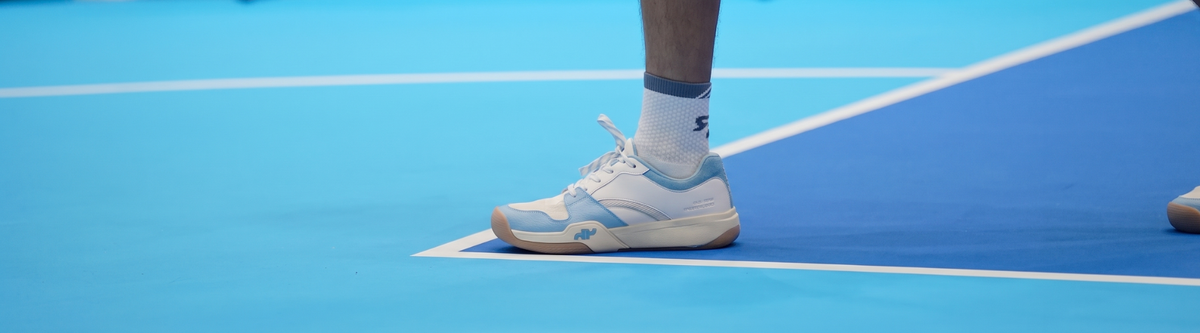
Pickleball asks a lot from your feet in a short amount of time. You shuffle sideways to cover the kitchen line, plant hard to stop, and pivot quickly to reset for the next shot, often for an hour or more without a break.
That repeated pattern is part of why foot and ankle injuries tied to pickleball rose roughly 6.5 times between 2019 and 2023, according to research presented at the American Orthopaedic Foot & Ankle Society's annual meeting, with Achilles tendon injuries showing up as the most common diagnosis.
That doesn't mean the sport is unusually dangerous; it means the movements are specific. A shoe built for walking or general gym use isn't shaped around a side shuffle or a hard plant.
If you already deal with a bunion, wide feet, or high arches, a shoe that doesn't account for those movements tends to expose the problem faster, which is exactly why fit matters more here than it does for a casual sneaker.
How the Side Shuffle Puts Pressure on a Bunion's Toe Box
A bunion is a bony bump that forms at the base of the big toe, and it's sensitive to sideways pressure.
Here's the mechanical problem: every side shuffle pushes off through the big toe joint while the foot slides laterally inside the shoe. In a narrow toe box, that motion presses the bunion against the shoe's lining with every push-off, over and over across a match. It's a different kind of stress than standing or walking in the same shoe.
This is where toe box shape becomes the deciding factor, not the shoe's name or price point. DAPS describes the men's Desi as true-to-size with a comfortable toe box, while the women's Desi is built as a snugger, performance-oriented fit by design, with an option to size up half a size for more forefoot room.
One verified buyer review of the women's Desi mentions the toe box working comfortably around a bunion, though individual experience can vary, so it's worth checking current reviews for your specific model and size. Either way, no shoe eliminates a bunion or guarantees pain-free play, and persistent pain is worth mentioning to a podiatrist.
Why Sprint-and-Stop Play Exposes Width and Heel Slip
Wide feet create a tension that shows up specifically in sports like pickleball. When you sprint toward a ball and then decelerate hard, your forefoot spreads and loads its full width against the shoe. If the shoe is too narrow, you get pinching along the sides of the foot right at the moment you need to plant with control.
The common fix, sizing up, solves the width problem but can create a new one: extra length often means extra room at the heel, and a loose heel is a liability during pickleball's quick direction changes, since your foot can slide inside the shoe instead of moving with it. Comfort for wide feet in this sport really comes down to solving both problems at once, not just one.
DAPS recommends players who want extra forefoot room size up half a size, for both the men's and women's Desi, while the Blumaka NonSlip insole built into every pair is meant to help keep the foot locked in place, so sizing up for width doesn't have to cost you heel stability.
How the Quick Pivot Puts Arch Support to the Test for High Arches
High arches behave differently from a neutral foot.
Pickleball's quick pivots, the fast reset before a dink or a scramble to cover a lob, load the foot in exactly the way that exposes this. A high arch needs the shoe to do more of the shock-absorbing work that the foot can't do on its own.
This is where midsole cushioning and structural support come in. DAPS shoes use an ETPU foam midsole built for energy return and cushioning, paired with an internal carbon fiber shank designed to add stability through sharp angle changes, the same movement pattern that puts the most demand on a high arch during a pivot.
What to Look for If More Than One of These Applies to You
Plenty of players deal with overlap, wide feet and a high arch, or a bunion on top of general width issues. When that's the case, a few practical checkpoints matter more than any single spec:
- A toe box shape that matches your foot
- A secure midfoot and heel fit, especially if you size up for width
- Real cushioning in the midsole to offset a rigid or high arch
- A clear return or exchange policy in case the fit isn't right the first time
On that last point, DAPS ships free within the U.S. and offers a 30-day return window if the fit doesn't work out; it's worth checking the specific terms on their site before you buy.
Final Takeaway
Comfort in a pickleball shoe isn't really about finding the "best" brand; it's about matching a shoe's toe box, width, and cushioning to what your specific foot needs during pickleball's exact movements.
A bunion reacts to the side shuffle, wide feet react to the sprint-and-stop, and high arches react to the pivot, each in a different way. Once you understand which movement stresses your foot type, choosing the right shoe becomes a much more specific, much less guesswork-heavy decision.
The Bottom Line on DAPS Fit
DAPS Fit built the Desi Low and Desi Mid specifically around pickleball's footwork rather than adapting a tennis or running shoe, with a carbon fiber shank for lateral stability, ETPU foam cushioning, a built-in Blumaka NonSlip insole, and clear sizing guidance (true-to-size with a comfortable toe box for men, a snug performance fit with a half-size-up option for women) to help you land closer to the right fit.
As fall league season and holiday shoe shopping ramp up, that combination gives players managing bunions, wide feet, or high arches a practical starting point, one grounded in how their foot actually moves on the court, not just a shoe with a good reputation.
Frequently Asked Questions About Comfortable Pickleball Shoes
Can the wrong shoe make a bunion feel worse during play?
A narrow toe box under repeated side-to-side pressure can irritate a bunion further during a match, so shoes with a toe box shape suited to your foot tend to feel more comfortable for players managing one. This isn't a medical treatment for the bunion itself.
Do high arches need more cushioning or more arch support?
Both matter, but cushioning tends to be the bigger factor for pickleball specifically, since high arches don't absorb shock as efficiently on their own during quick pivots and stops.
Should I size up if I have wide feet?
Many players with wide feet do size up for forefoot room, but pairing that with a shoe that has a secure midfoot and heel lockdown (like a well-fitted insole) helps prevent the heel slip that sizing up can otherwise cause.

Leave a comment
This site is protected by hCaptcha and the hCaptcha Privacy Policy and Terms of Service apply.