


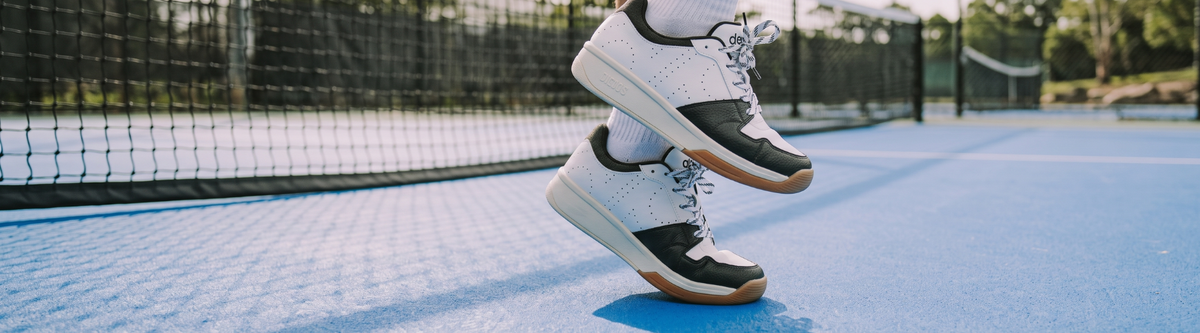
If you've shopped for pickleball shoes recently, you've probably noticed every listing claims "maximum cushioning." What those listings rarely explain is that not all cushioning is built the same, or that it behaves very differently after a few months of real play. The foam sitting under your foot on day one is not the same foam you're standing on by week twelve, and the material it's made from decides how big that gap turns out to be.
This is really a conversation about two foam types: standard EVA (ethylene vinyl acetate), which has cushioned sneakers for decades, and ETPU (expanded thermoplastic polyurethane), a newer bead-foam technology that's shown up in performance footwear because it holds energy return more consistently.
DAPS builds its Desi line of pickleball shoes around ETPU midsoles for exactly this reason, and we'll get into how that fits later. First, let's look at what actually separates these two materials and why it matters more in pickleball than in almost any other racquet sport.
What's the Real Difference Between EVA and ETPU Foam?
Standard EVA foam is made by mixing chemicals into a single block, injecting or molding it into a shoe shape, and letting it set. It's a solid, uniform piece of foam, which is why it's cheap to produce and used almost everywhere. The tradeoff is that once those internal cell walls collapse from repeated compression, they don't fully recover.
ETPU foam works differently. Small TPU pellets are pre-expanded, then fused together with steam or heat inside a mold, so the final midsole is made of thousands of tiny, independently springy beads rather than one continuous slab. Each bead compresses and rebounds a bit on its own, so the structure as a whole tends to keep more of its shape and energy return over repeated use.
This bead structure is also why ETPU midsoles generally feel more consistent across temperature swings than EVA, which tends to firm up in cold weather and soften in heat.
Why Does Cushioning Compression Matter So Much in Pickleball?
Instead of loading your midsole evenly across a long run, pickleball hits it with quick, repeated compressions: a split step, a lateral shuffle, a hard stop, and a toe-off drive back toward the kitchen line, over and over for an hour or more. Foam that can't recover its shape quickly between these bursts starts to feel flat exactly where you need bounce the most, right at the forefoot and heel strike zones.
How Long Does EVA Foam Actually Hold Its Bounce?
This isn't a new question in footwear science, since running shoes have been studied for decades. Early foundational research by Cook et al. found that EVA-cushioned running shoes retained roughly 67% of their original shock-absorbing capacity after 160 to 240 km of use, and less than 60% after 400 to 800 km. Later work by Verdejo and Mills measured a 15% drop in energy absorbed by EVA foam after the equivalent of about 270 km of simulated running.
Those numbers come from running studies, not pickleball-specific testing, and mileage doesn't translate one-to-one to court hours. But the underlying mechanism (foam cells collapsing under thousands of repeated compressions) is the same one at work every time you plant, cut, or drive off the balls of your feet at the net.
If anything, pickleball's stop-start pattern loads the forefoot foam through more compression cycles per hour than a steady jog does, simply because there's so little smooth, continuous movement to spread the load out.
Does ETPU Cushioning Really Last Longer on Court?
Because each bead in an ETPU midsole compresses somewhat independently, the material as a whole tends to resist the kind of permanent cell collapse that flattens single-piece EVA foam. This is a big part of why ETPU has become popular in performance footwear built for repeated, high-impact movement rather than steady, one-direction miles.
DAPS reports that its ETPU midsole was tested independently at Heeluxe Performance Lab, with results showing higher energy return, better stability, and improved movement efficiency for short-court sports. DAPS separately states its cushioning showed superior shock absorption in lab testing.
We can't independently verify a private lab's full results, so take these as the manufacturer's reported findings rather than a third-party guarantee, but they line up with what's generally understood about how bead-foam structures behave under repeated compression compared with molded EVA.
How to Judge Cushioning Durability and Rebound for Your Own Game
You don't need a lab to get a decent read on your own shoes. A few simple checks:
- The thumb-press test. Press firmly into the forefoot and heel foam on a well-worn shoe, then do the same on a fresh pair. If the worn foam stays visibly dented longer before springing back, the compression set has already set in.
- The court-feel check. Pay attention to whether your shoes suddenly feel "harder" or less responsive after a few months, especially if you didn't change anything else about your game. That shift is usually foam fatigue.
- Match your play style to the wear pattern. Net rushers and players who load the forefoot heavily on drives and dinks tend to compress that zone faster than baseline-heavy players, so check the forefoot foam specifically.
- Track frequency. Someone playing four times a week will compress cushioning far faster than someone playing once every other week, regardless of how many months they've owned the shoes.
When Is the Right Time to Upgrade Your Cushioning?
Two natural checkpoints make sense for most players. The first is the start of a new season or league session, since walking into competitive weeks on compressed foam means you're playing your sharpest matches with your weakest cushioning. The second is around seasonal sales periods, when it's worth trying a shoe with a different midsole approach if your current pair has already gone flat mid-season before.
If you've felt that specific letdown, cushioning that felt great in the store but went dead by the second half of the season, that's the gap ETPU-based midsoles are generally built to close.
Final Takeaway
The real difference between a pickleball shoe that still feels great in month six and one that goes flat by month two usually comes down to the foam's compression set. EVA is affordable and familiar, but the same research that's tracked its shock absorption in running shoes for decades shows a clear pattern of it losing bounce under repeated impact.
ETPU's bead structure is built to resist exactly that kind of collapse, which is why it holds up better through the specific stop-start, toe-off-heavy demands of pickleball.
Why Players Are Turning to DAPS for Cushioning That Holds Up
DAPS's Desi Low and Desi Mid pickleball shoes use an ETPU midsole, paired with a carbon fiber shank for added stability and a Blumaka NonSlip insole, so the foam's energy return works alongside the rest of the shoe rather than on its own. If your current pair has already gone soft and dead by mid-season, it might be worth trying a shoe built around cushioning designed to hold its bounce for the long haul.
FAQs
What is ETPU foam made of?
ETPU stands for expanded thermoplastic polyurethane. It's made by pre-expanding small TPU beads and fusing them together under heat and pressure, rather than molding one solid block the way EVA is made.
Is ETPU foam better than EVA for pickleball shoes?
For durability and rebound over repeated compression, ETPU generally holds its shape and energy return longer than standard EVA. EVA still works fine for casual, low-frequency play; the gap shows up most for players on court multiple times a week.
How often should I replace pickleball shoes for cushioning reasons?
There's no single number that fits every player, since it depends on play frequency, body weight, and playing style. A more useful signal is the thumb-press or court-feel checks described above, done every few months.
Can I tell if my shoe's foam has compressed just by looking at it?
Sometimes you'll see visible creasing or a flattened forefoot, but compression often happens before it's visually obvious. Feel and rebound tests catch it earlier than eyeballing the shoe.

Leave a comment
This site is protected by hCaptcha and the hCaptcha Privacy Policy and Terms of Service apply.