


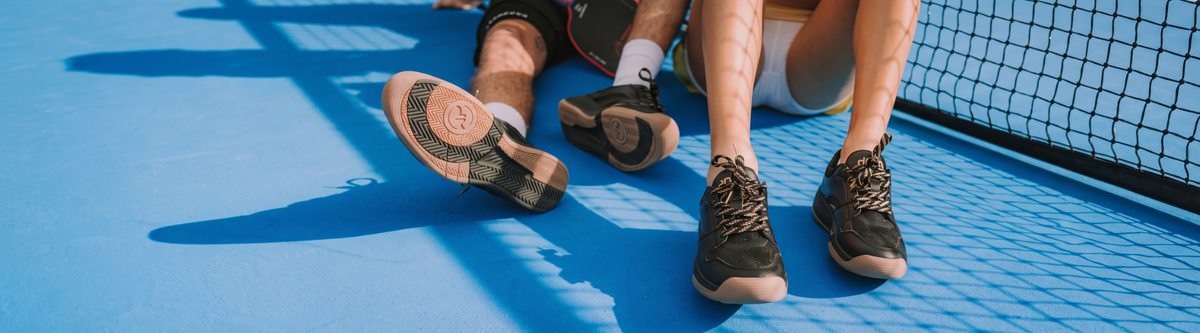
Finding the Right Shoe for Indoor Play
Indoor pickleball has its own demands. Gym floors and hard courts are smoother than outdoor asphalt, so the way a shoe grips, cushions, and holds your foot in place matters more than most players expect. A shoe that works fine outdoors can feel unstable indoors, especially during the fast side-to-side movement that pickleball requires.
That's the gap the Women's DAPS Desi Low and Desi Mid are built to close. Both were designed specifically for women's feet and for the short, explosive movements of the kitchen line, with non-marking soles that are made for indoor courts. Below, we'll walk through what each shoe offers, what real players and coaches have said about them, and what to look for as you shop.
What Should You Look For in an Indoor Pickleball Shoe?
Before comparing specific pairs, it helps to know what actually matters on an indoor court. A stat on why footwear choice matters at all: a peer-reviewed lower-extremity injury study found sudden direction changes are the leading injury mechanism in pickleball, and ankle sprains are the single most common diagnosis (21.7% of cases).
- Non-marking soles: Most indoor facilities require rubber that won't leave scuffs on gym floors.
- Lateral support: Pickleball involves constant side-to-side cuts, so a shoe needs structure that supports that motion, not just forward running.
- Secure, snug fit: A shoe that shifts during quick direction changes can throw off your footwork.
- Cushioning that doesn't sacrifice ground feel: You want comfort over a long session without feeling disconnected from the court.
With that in mind, here are the two DAPS options built for exactly this kind of play.
Women's DAPS DESI Low: Built for Speed and Everyday Comfort
The Women's DAPS Desi Low ($159.99) is a low-profile shoe designed from the ground up for women, not resized from a men's pattern. It's built around an ETPU midsole that's meant to return energy through quick cuts and transitions, paired with a carbon fiber shank that supports stability on fast lateral movement.
Inside, the Blumaka NonSlip Insole is designed to help keep the foot locked in during play, and the CNC-cut rubber outsole is non-marking, so it's suited to indoor courts without leaving scuffs behind.
Fit runs snug through the forefoot to support quick footwork. If you prefer a little more room up front, DAPS recommends going up half a size. A few customer reviews on the site mention the toe area feeling roomy, which reviewers noted was a plus for wider feet or bunions.
- Best for: players who prefer a low-cut shoe for fast footwork
- Standout features: carbon fiber shank, Blumaka NonSlip Insole, non-marking outsole
- Price: $159.99
Women's DAPS DESI Mid: Built for Extra Ankle Support
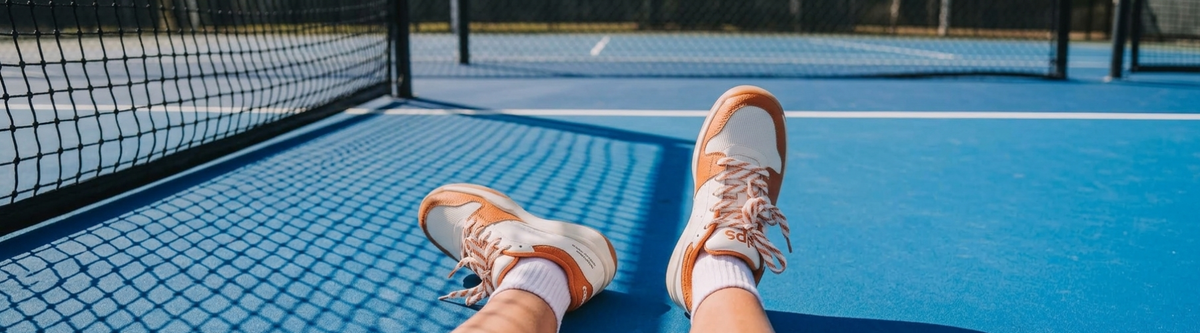
The Women's DAPS Desi Mid ($174.99) shares the same core technology as the Desi Low, including the ETPU midsole, carbon fiber shank, and Blumaka® NonSlip Insole. The real difference is the cut: the Desi Mid uses a higher, mid-top construction, which DAPS describes as an ankle-reinforced build, wrapping more coverage around the ankle than the low-cut Desi Low.
This makes the Desi Mid a good option for players who want extra coverage during sharp direction changes, or who simply prefer more structure around the ankle for longer sessions on the court. Like the Desi Low, it uses a non-marking outsole suited to indoor play, along with the same breathable upper construction.
Sizing follows the same guidance as the Desi Low: a snug, performance fit through the forefoot, with the option to size up half a size for extra room.
- Best for: players who want more ankle coverage and structure
- Standout features: Carbon fiber shank, Blumaka NonSlip Insole
- Price: $174.99
Why Lab-Tested Traction Matters on Indoor Courts
Grip is one of the hardest things to judge from a product photo. DAPS says its shoes have gone through two separate kinds of evaluation: testing by competitive pickleball players handling quick reactions and sharp cuts, and independent lab testing at Heeluxe, a footwear performance facility that measures traction, stability, and movement efficiency.
For shoppers, this matters because it means the traction and stability claims aren't just marketing copy. They've been put through structured evaluation rather than judged on look alone. That said, no shoe can promise a fall-free game; court conditions, playing style, and how a shoe is cared for all play a role in performance.
What Real Players and Coaches Say About DAPS
Beyond the lab, DAPS shoes have been worn and reviewed by people who play and coach the sport regularly. Pro pickleball player Alex Walker has shared that switching to DAPS helped reduce foot pain during long sessions on the court. Pickleball coach Tyler Besse has said his feet hold up better through full days of coaching while wearing them.
Padel pro Nacho Garcia has praised the grip specifically, noting he's had no slippage while wearing the shoes. These are individual experiences rather than guarantees, but they reflect the kind of real-world feedback that matters when you're choosing a shoe for regular play.
Final Takeaway
Choosing between the Women's DAPS Desi Low and Desi Mid really comes down to how you like to move on the court. If you prefer a lower-cut shoe for quick footwork, the Desi Low is the simpler pick. If you'd rather have extra ankle coverage for peace of mind during long sessions, the Desi Mid is worth the slightly higher price.
Either way, you're getting a shoe built specifically for women's feet, backed by independent lab testing, and designed around the kind of movement that indoor pickleball actually demands, rather than a shoe that was simply borrowed from another sport.
Ready to Find Your Fit?
DAPS built the Desi Low and Desi Mid from the ground up for women's pickleball, combining a carbon fiber shank, a Blumaka® NonSlip Insole, and non-marking traction tested at Heeluxe. If you're ready to see which one fits your game, you can shop the full women's collection at DAPS.
Frequently Asked Questions
What's the difference between the Women's DAPS Desi Low and Desi Mid?
The main difference is the cut. The Desi Low has a lower-profile build, while the Desi Mid uses a higher, mid-top construction for extra ankle coverage. Both share the same midsole, shank, and insole technology.
Can I wear the Desi Low or Desi Mid outside of indoor courts?
Yes. DAPS designed these shoes for the fast footwork of pickleball generally, and they're suited to both indoor and outdoor courts, along with other court sports like padel and basketball.
Do I need the Mid or the Low if I have ankle concerns?
If you want more structure and coverage around the ankle, the Desi Mid's higher, mid-cut build is designed with that in mind. Players who prefer a lower-cut feel tend to choose the Desi Low. If you have a specific medical concern, it's worth checking with a healthcare professional about what kind of support suits you.

Leave a comment
This site is protected by hCaptcha and the hCaptcha Privacy Policy and Terms of Service apply.