


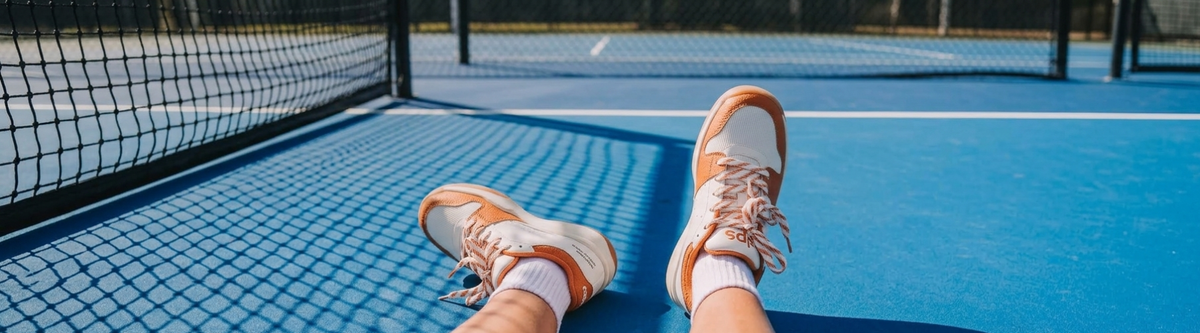
Search "best indoor pickleball shoes" and you'll find plenty of generic court shoe roundups, most borrowed from tennis or basketball buying guides. Indoor pickleball has its own demands: a shorter court, quicker resets, and far more time spent moving laterally instead of running in straight lines. A shoe built for that job looks and performs differently than one built mainly for a hard court outside.
This guide breaks down what actually makes a shoe "indoor ready," then walks through DAPS DESI Low and DESI Mid, two models built specifically for pickleball rather than adapted from another sport.
What Makes a Shoe "Indoor Ready" for Pickleball?
Why Non-Marking Soles Matter on Hardwood
Most indoor pickleball facilities, rec centers, and gyms require non-marking rubber outsoles. Standard outdoor rubber compounds can leave scuff marks or dark streaks on finished wood, which is why many venues won't let you on the court without them. A non-marking sole isn't really a performance upgrade so much as a ticket to play indoors at all.
Beyond the rules, non-marking rubber tends to be formulated for cleaner release on smooth surfaces, which matters when you're pivoting in the kitchen or recovering after a dink.
How Tread Pattern Changes Grip on Wood
Indoor pickleball involves constant side-to-side footwork: split steps, quick recoveries, short bursts toward the kitchen line. A tread designed with multi-directional or herringbone cuts is built to hold on both forward pushes and lateral shifts, which is different from a running shoe tread designed mainly for moving in one direction.
CNC-cut tread (versus stamped or molded tread) tends to have sharper, more defined edges, which can translate into more consistent grip through repeated stop-and-go movement.
Why Lateral Support Matters More Indoors Than You'd Think
Hardwood courts are unforgiving on a shoe that flexes too much side to side. A reinforced shank (often carbon fiber) resists twisting through the midfoot, supporting the foot during sharp cuts and quick direction changes. Paired with a snug, locked-in upper, this kind of support helps the foot stay aligned instead of rolling during a fast reset.
No shoe removes the physical demands of the sport, though. Research summarized by the American Orthopaedic Society for Sports Medicine notes that injuries to the lower extremity account for close to 29% of all reported pickleball injuries, with ankle sprains from sudden direction changes among the most common. Supportive footwear is one part of managing that risk, not a guarantee against it.
Why Cushioning Affects the Whole Session
A hardwood court has almost no natural give compared to an outdoor surface, so cushioning matters more indoors, not less. A responsive midsole foam absorbs impact on repeated stops and returns some of that energy on your next push, which is part of why legs tend to feel fresher deeper into a long indoor session.
Which DAPS Shoe Fits Indoor Play?
Both DAPS DESI models were built from the ground up for pickleball rather than adapted from tennis or training shoes, and both share the same core technology. The difference between them comes down to cut and fit preference.
DAPS DESI Low: Built for a Lighter, Quicker Feel
The DESI Low is DAPS's low-cut model, priced at $159.99 and available in men's and women's fits.
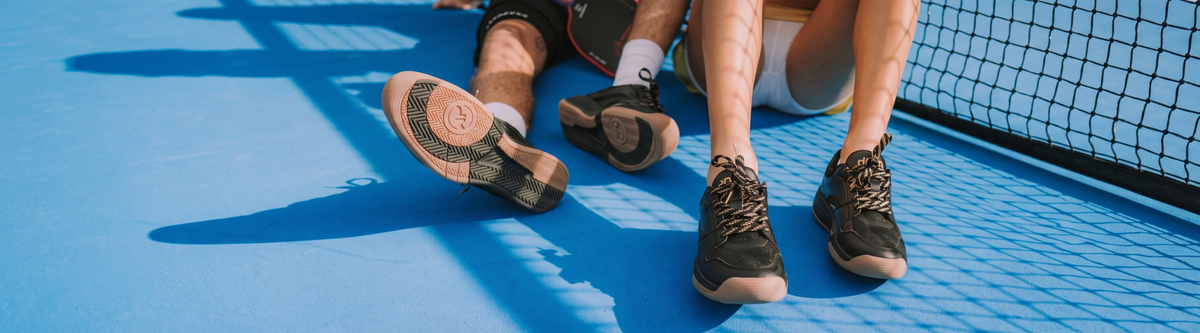
- Non-marking, CNC-cut rubber outsole: designed to grip hardwood and other hard court surfaces without leaving marks on the floor.
- ETPU midsole foam: cushions landings and returns energy through long rallies and multi-game sessions.
- Carbon fiber shank: adds torsional stability through the midfoot for sharper cuts and quicker resets.
- Blumaka NonSlip Insole: a recycled-foam insole designed to help keep the foot in place during pivots and lateral movement.
- How it helps players: The low-cut profile trims excess material for a lighter overall shoe, which suits players who prioritize quick movement.
DAPS DESI Mid: Built for Extra Ankle Coverage
The DESI Mid carries the same core technology as the Low in a higher-cut silhouette. It's priced at $174.99 and also available in men's and women's fits.
- Same non-marking, CNC-cut outsole as the Low, so it meets the same indoor court requirements.
- ETPU midsole and carbon fiber shank, carried over from the Low for consistent cushioning and lateral stability.
- Blumaka NonSlip Insole, included for foot lockdown through pivots.
- Higher-cut upper: adds extra structure around the ankle area, which some players prefer for a more secure, wrapped-in feel during aggressive lateral play.
- How it helps players: this is a good fit for players who want additional coverage around the ankle, or who simply prefer a mid-top silhouette, without giving up any of the traction or stability built into the Low.
Both models have been tested at Heeluxe Performance Lab, an independent footwear testing facility; DAPS reports stronger energy return and shock absorption results in that testing compared to standard tennis sneakers repurposed for pickleball. Every DAPS order also includes free US shipping and a 30-day return window, so choosing between the Low and Mid doesn't have to be a one-shot decision.
Final Takeaway
Choosing indoor pickleball shoes really comes down to three things: a non-marking sole that meets your facility's rules, a tread pattern built for lateral movement rather than straight-line running, and enough structure through the midfoot to support quick direction changes on an unforgiving hardwood surface. Cushioning matters too, especially across multiple games in a row.
DAPS built the DESI Low and DESI Mid around exactly those requirements: non-marking, CNC-cut outsoles, a carbon fiber shank for stability, ETPU foam for cushioning, and a Blumaka NonSlip Insole for foot lockdown, all tested independently at Heeluxe Performance Lab. Whether you want the lighter low-cut feel or the added ankle coverage of the mid, DAPS gives indoor players a shoe built for the sport they're actually playing.
FAQs
Do indoor pickleball courts really require non-marking shoes?
Many do. Gyms, rec centers, and dedicated pickleball facilities commonly restrict court access to non-marking soles to protect the wood floor finish. Policies vary by venue, so it's worth checking with your specific facility, but it's safest to assume non-marking is a requirement rather than a suggestion.
Can I just wear my running shoes indoors?
You can, but running shoes are built for forward motion, not the lateral cuts and quick stops pickleball demands. Their tread and midsole aren't designed for the same side-to-side loading, which is why court-specific or pickleball-specific shoes tend to feel more stable during rallies.
What's the real difference between DAPS DESI Low and DESI Mid?
The core technology (outsole, midsole, shank, and insole) is the same across both. The difference is the cut: the Low sits below the ankle for a lighter feel, while the Mid extends higher for extra ankle-area coverage. Choosing between them mostly comes down to personal fit preference.
Do non-marking soles wear out faster than regular rubber?
Wear rate depends more on how often you play and the surface you're playing on than on whether a sole is non-marking. Checking tread wear regularly is a good habit no matter which shoe you choose.


Leave a comment
This site is protected by hCaptcha and the hCaptcha Privacy Policy and Terms of Service apply.