


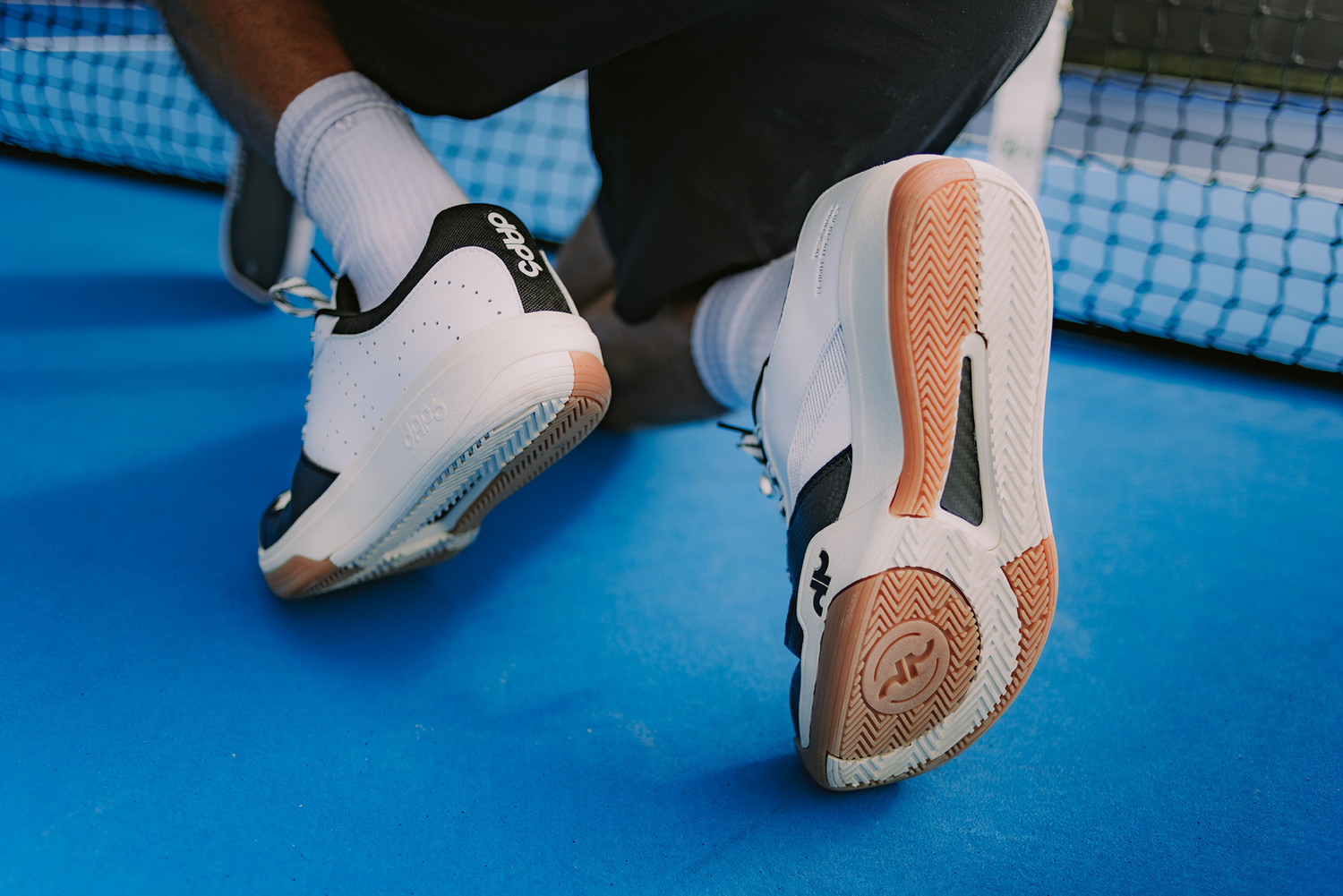
You go for a wide forehand. Hard plant. Quick push back to center.
Pop.
Maybe not a rupture. Maybe just that sharp, nagging burn at the back of your heel that won’t quit.
Achilles tendinitis is one of the most common overuse injuries in pickleball. And it makes sense. The game is built on:
• Explosive lateral drives
• Sudden stops at the kitchen line
• Fast transitions from soft dinks to full-power cuts
• Repeated loading and unloading of the heel
When your shoes don’t control heel movement, that force doesn’t just disappear. It travels straight through the Achilles tendon.
Let’s be clear upfront:
DAPS shoes do not treat, cure, or fix Achilles tendinitis or ruptures. That’s a medical issue that should be addressed by a healthcare professional.
What we can say — based on player feedback, biomechanics, and footwear testing — is this:
Players coming back from Achilles pain consistently tell us that stable, purpose-built pickleball shoes help them return to play with more confidence and less aggravation.
And that’s not by accident.
⸻
Why Pickleball Is Tough on Your Achilles
The Achilles tendon connects your calf muscles to your heel bone. It absorbs force every time you:
• Push off for a lateral drive
• Decelerate into the kitchen
• Land from a quick hop reset
• Recover after a stretched-out drop shot
Now here’s where most players get into trouble.
They’re wearing:
• Repurposed running shoes
• Worn-down tennis shoes
• Soft foam trainers built for straight-line motion
Pickleball is not straight-line motion.
It’s hard stops. Hard cuts. Micro-adjustments. Split steps. Rebounds.
When your heel slides inside the shoe during those movements, your Achilles tendon absorbs extra strain. Multiply that by hundreds of points per week, and inflammation shows up fast.
That’s exactly why understanding why pickleball needs different shoes matters .
⸻
The #1 Problem: Heel Instability During Abrupt Stops
Most Achilles irritation in pickleball comes from uncontrolled deceleration.
Picture this:
You sprint for a deep ball.
You slam the brakes.
Your heel shifts inside your shoe.
Your ankle rolls slightly inward.
That tiny movement creates additional strain at the back of the heel.
Over time, that repeated micro-instability can irritate the tendon.
This is why heel lockdown and lateral containment are non-negotiable for serious players.
⸻
How Purpose-Built Pickleball Shoes Support Return to Play
Again — we’re not claiming medical treatment.
We’re talking about mechanical support and performance stability.
Here’s where DAPS shoes make a difference.
⸻
1. Heel Control That Reduces Unwanted Movement
Loose heel counters = unstable deceleration.
DAPS shoes are built with structured heel containment designed specifically for pickleball’s lateral and stop-start demands.
Instead of your heel floating inside the shoe during a hard stop, you get:
• A more secure lockdown
• Reduced internal slippage
• Better alignment during cuts
Less movement inside the shoe means less chaotic load transfer to the Achilles.
Players returning from Achilles flare-ups often say this is the first thing they notice.
⸻
2. ETPU Midsole: Energy Return Without Mushy Instability
Cushioning matters — but not all cushioning is equal.
Soft EVA foam can compress unevenly during lateral motion. That instability forces your lower leg and Achilles to compensate.
DAPS uses an ETPU midsole engineered for:
• High energy return
• Consistent responsiveness
• Long-term structural integrity
ETPU doesn’t pack out the way basic foam does. That means your platform stays consistent over time — which matters when you’re rebuilding trust in your movement.
Instead of feeling like you’re sinking into the shoe, you get controlled rebound.
Controlled rebound = smoother push-off = less shocky strain on the tendon.
⸻
3. Carbon Fiber Shank for Midfoot Stability
Midfoot collapse can increase tension up the posterior chain — including the Achilles.
That’s where the carbon fiber shank comes in.
It:
• Reinforces torsional rigidity
• Reduces excessive twisting
• Creates a stable base for lateral transitions
When you plant and rotate into a drive, the shoe supports the motion instead of allowing your foot to torque unpredictably.
That structural integrity helps serious players move with more confidence — especially during high-speed exchanges at the net.
⸻
4. Blumaka NonSlip Insole: The Unsung Hero
Internal slippage is a silent Achilles killer.
Even if the outsole grips the court, if your foot slides inside the shoe, the tendon still takes the hit.
DAPS integrates Blumaka NonSlip insoles designed to:
• Improve foot-to-shoe grip
• Reduce internal sliding
• Enhance proprioceptive stability
Less sliding = better control during stops.
Better control = smoother load transfer.
That internal traction matters just as much as outsole grip.
⸻
5. Court-Specific Traction That Controls Deceleration
If your outsole is too slick, you overcompensate.
If it’s too sticky, you risk awkward torque.
DAPS traction is engineered specifically for pickleball surfaces — both indoor and outdoor — with grip patterns that allow controlled stops rather than abrupt jolts.
This directly ties into pickleball shoe traction and stability, two of the most important buyer research factors .
Good traction isn’t just about not slipping.
It’s about decelerating smoothly.
And smooth deceleration protects the entire lower chain — Achilles included.
⸻
What Players Tell Us After Achilles Issues
We hear this pattern again and again:
• “I didn’t realize how unstable my old shoes were.”
• “I finally feel locked in during cuts.”
• “I trust my stops again.”
• “My heel doesn’t feel aggravated after long sessions.”
Notice what they’re not saying.
They’re not claiming we cured their injury.
They’re saying they can move confidently again.
That confidence matters when you’re coming back from something that kept you off court.
⸻
Important: Footwear Is One Piece of the Puzzle
If you’re dealing with Achilles tendinitis or recovering from a rupture:
• Work with a medical professional
• Follow a structured rehab plan
• Gradually reintroduce explosive movement
• Avoid jumping back into tournament intensity too soon
Shoes support the system.
They don’t replace rehab.
But once you’re cleared to return to play, wearing stable, purpose-built pickleball shoes instead of repurposed trainers is a smart move.
⸻
Why Repurposed Shoes Make Things Worse
Let’s address it directly.
Are tennis shoes good for pickleball? 
They’re better than running shoes — but they’re still not engineered specifically for pickleball’s unique movement profile.
Running shoes:
• Built for forward motion
• Soft lateral walls
• High heel-to-toe drop variability
That combination can amplify instability during side-to-side movement.
Tennis shoes:
• Built for bigger court coverage
• Different slide dynamics
• Not optimized for compact, high-frequency kitchen play
Pickleball requires tight, repetitive, micro-bursts of movement in a small space.
That’s why we say:
Purpose-built for pickleball. Not repurposed.
⸻
If You’re Returning From Achilles Pain, Look For This
When evaluating the best pickleball shoes for your situation, focus on:
• Heel lockdown
• Lateral stability
• Torsional rigidity
• Controlled cushioning
• Court-specific traction
Avoid:
• Ultra-soft foam
• Minimal heel containment
• Generic cross-trainers
• Worn-down outsoles
Your Achilles doesn’t need guesswork. It needs stability.
The Bigger Picture: Protecting Your Game Long-Term
Achilles injuries don’t just affect your heel.
They change how you move.
You start avoiding wide balls.
You hesitate on quick drives.
You back off aggressive cuts.
That hesitation costs points.
When your footwear supports your movement, you can focus on strategy, not survival.
And that’s what serious players want — whether you’re grinding league nights or chasing medals on tournament weekends.
⸻
If you’re dealing with Achilles tendinitis or coming back from a rupture, get medically cleared first.
Then ask yourself:
Are my shoes helping me… or fighting me?
DAPS was built from the ground up for pickleball’s stop-start chaos:
• ETPU midsole for responsive energy return
• Carbon fiber shank for torsional control
• Structured heel containment
• Blumaka NonSlip insole for internal stability
• Traction engineered for real court conditions
We don’t fix injuries.
But we build shoes that help serious players move with confidence again.
And when you trust your movement, you get back to what matters:
Winning the kitchen.
Driving with authority.
Cutting without hesitation.
Back on your feet. Back in the game.


Leave a comment
This site is protected by hCaptcha and the hCaptcha Privacy Policy and Terms of Service apply.