




Padel vs. Pickleball: Court, Rules, Gear and the Right Shoes for Each
The short answer
Padel and pickleball are both doubles-friendly paddle sports, but padel is played on a larger 20 x 10 meter court enclosed by glass walls that stay in play, with tennis scoring and a pressurized ball. Pickleball uses an open 20 x 44 foot court, a kitchen (no-volley zone) and a plastic wiffle-style ball. Both reward quick lateral movement, so both demand a true court shoe.
The short answer: Padel and pickleball are both doubles-friendly paddle sports, but padel is played on a larger 20 x 10 meter court enclosed by glass walls that stay in play, with tennis scoring and a pressurized ball. Pickleball uses an open 20 x 44 foot court, a kitchen (no-volley zone) and a plastic wiffle-style ball. Both reward quick lateral movement, so both demand a true court shoe.
Key takeaways
- About 1.07 million Americans played padel in 2025, the first year SFIA tracked it. Pickleball had 24.3 million.
- The biggest gameplay difference is the walls. In padel, the ball can bounce once and then off the glass and still be played.
- Padel uses tennis scoring (15, 30, 40, game). Pickleball uses its own scoring to 11.
- Padel courts are usually artificial turf with sand infill; pickleball courts are usually hard acrylic or indoor wood and sport tile.
- A pickleball court shoe works well for padel on hard and indoor surfaces. On sand-filled turf, a padel-specific herringbone or clay-style outsole grips better.
Padel vs. pickleball at a glance
| Padel | Pickleball | |
|---|---|---|
| Court size | 20 m x 10 m (about 66 x 33 ft) | 44 x 20 ft (13.41 x 6.1 m) |
| Walls | Glass and mesh; walls are in play | Open court; no walls in play |
| Net height (center) | 88 cm (about 34.6 in) | 34 in (86 cm) |
| No-volley zone | None | 7 ft kitchen on each side |
| Ball | Pressurized, tennis-style | Perforated plastic |
| Paddle/racket | Solid, perforated, stringless | Solid paddle, no holes |
| Serve | Underhand, after a bounce | Underhand |
| Scoring | Tennis scoring | Pickleball scoring to 11 |
| Typical surface | Artificial turf with sand | Acrylic hard court, wood, sport tile |
| U.S. players (2025) | About 1.07 million | 24.3 million |
How the games feel different
Pickleball is a game of patience at the kitchen line. The no-volley zone forces soft dinks and resets, then explodes into fast hand battles. Most movement is short and lateral.
Padel is a game of angles. Because the back and side glass stay in play, you can let a hard shot go by, play it off the wall and keep the point alive. Rallies run longer, you move more front to back, and overhead "bandeja" and "vibora" shots replace pickleball's resets.
Both are doubles-first, both are easy to learn and both are growing fast. The USPA reports just over 1,000 padel courts open across 31 states as of April 2026.
Equipment differences
- Paddles: Padel rackets are thicker, perforated and use a foam core with a wrist strap. Pickleball paddles are flat-faced with no holes.
- Balls: Padel uses a pressurized ball that looks like a tennis ball with slightly less pressure. Pickleball uses a perforated plastic ball, with separate indoor and outdoor versions.
- Shoes: This is where the surfaces matter.
What shoes should you wear for padel and pickleball?
Both sports punish the wrong shoe. Running shoes are built for forward motion and roll on lateral cuts. You need a court shoe with a stable base, lateral support and a flatter outsole.
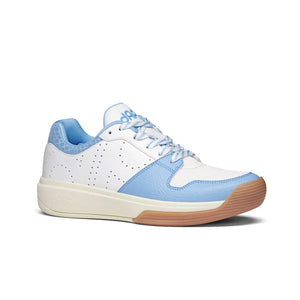
For pickleball (hard courts and indoor): Look for a durable, non-marking court outsole, a stable midfoot and a heel that doesn't slip on hard stops. The DAPS DESI Low and DESI Mid were built for this: a carbon fiber shank for lateral stability, an ETPU midsole for energy return and a Blumaka NonSlip insole so your foot doesn't slide inside the shoe.
For padel on hard or indoor courts: The same pickleball court shoe works well. The movement patterns (split steps, lateral pushes, quick pivots) are close.
For padel on sand-filled turf: The sand changes traction. Dedicated padel shoes use herringbone or omni/clay-style outsoles that bite into turf and release sand. If most of your padel is on turf, a padel-specific outsole is the better choice.
Playing both? Use a pickleball court shoe for hard and indoor courts, and keep a padel-specific pair if you play turf padel regularly.
Which sport should you play?
You don't have to choose. Many clubs now offer both, and the skills transfer: soft hands, split steps and doubles positioning help in each. If you like long rallies and creative angles, padel will hook you. If you like quick hands and a game you can play at the park tonight, pickleball is easier to find.
Frequently asked questions
Is padel harder than pickleball? Most players find padel's walls and overhead game take longer to learn, while pickleball is quicker to pick up. Both are beginner-friendly compared to tennis.
Is a padel court bigger than a pickleball court? Yes. A padel court is 20 x 10 meters (about 66 x 33 feet). A pickleball court is 44 x 20 feet.
Can you use pickleball shoes for padel? On hard and indoor courts, yes. On sand-filled artificial turf, a padel shoe with a herringbone or clay-style outsole will grip better.
Do padel and pickleball use the same scoring? No. Padel uses tennis scoring. Pickleball games are typically played to 11, win by 2.
How many people play padel in the U.S.? About 1.07 million Americans played padel in 2025, according to SFIA's 2026 Topline Participation Report.
One shoe for the short-court game
If your week includes pickleball, indoor padel or both, the DESI is built for the quick, lateral movement they share. Shop DESI Low and DESI Mid.
Related: TYPTI, the new racquet sport played on pickleball courts and are tennis shoes good for pickleball?
Sources
- USPA, Padel Surpasses One Million Players in the United States: https://padelusa.org/padel-surpasses-one-million-players-in-the-united-states/
- SFIA, U.S. Pickleball Participation Statistics: https://sfia.org/research/u-s-pickleball-participation/
- Insure4Sport, Pickleball vs Padel (court sizes, net heights, walls): https://www.insure4sport.co.uk/blog/pickleball-vs-padel/
- PPA Tour, Padel vs. Pickleball (scoring): https://ppatour.com/ppa-blog/padel-vs-pickleball/
- Pokita, Padel vs. Pickleball (court and ball comparison): https://www.pokita.co.uk/?p=9862
- The Kitchen, DAPS DESI tech (carbon shank, ETPU, Blumaka): https://shop.thekitchenpickle.com/products/daps-men-s-low